Lessons From My Difficult Dog

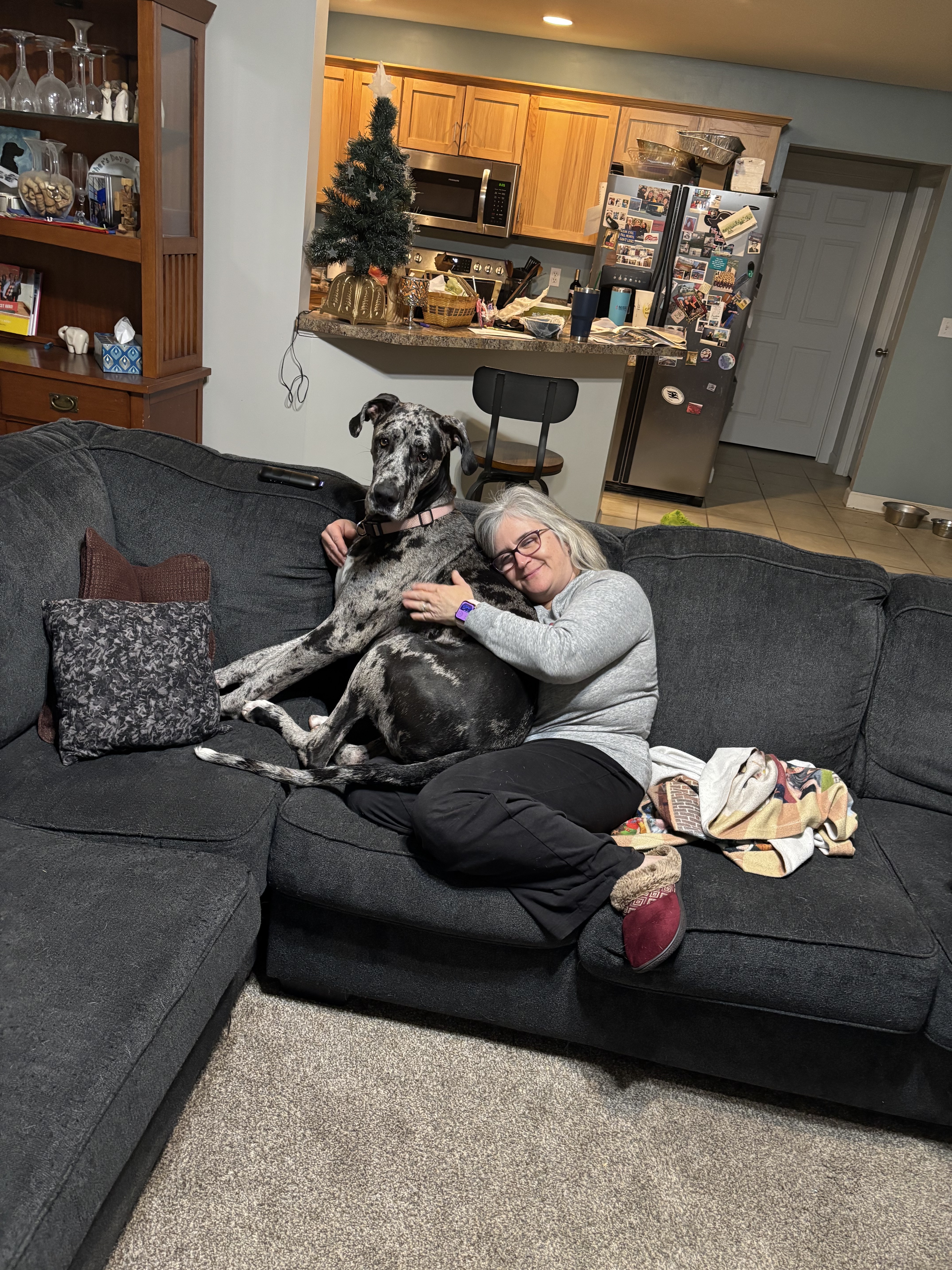
About two years ago, my husband and boys and I drove just over an hour to a small farm to pick up our new puppy–Roxie, a Great Dane. We didn’t set out to get Roxie. I had no desire for a female dog. But as we sat amidst the wriggling, snuffling, tumbling, group of pups, she crawled into my husband’s lap, laid down, and promptly fell asleep. To us, it seemed that she was saying, “These will be my people.”

And so we were. And so we are. But life with Roxie isn’t at all what we envisioned. We’re no strangers to giant dog breeds, so we thought we had it covered. But then Roxie came and showed me that I don’t know anything. Roxie is playful, and cuddly. She’s smart and goofy. But she’s also willful and impulsive, as well as reactive and defensive. We’ve done a lot of work with Roxie over the past couple of years, from socialization to group training and even some individual training to work on issues of resource guarding. And still, it can be a struggle. Most recently, she became aggressive with our older dog, sending him to the vet two days in a row for sutures. And she bit another dog while we were out on a hike.

To say that I reached the end of my tether was an understatement. How could this dog, who spends 90 percent of her time cuddling with others on the couch, be so difficult? How were my husband and I, who had done everything we were supposed to do, be in this situation? Why do other people have such an easy time with their dogs? Why can’t I have the dog I envisioned when we set out on this journey together? Why can’t things be different?

All of us, at one point or another, end up in situations that are vastly different from what we envisioned. Sometimes, they’re better. A missed opportunity, a broken heart, a major disappointment paves the way for something greater, something we never could have envisioned on our own.

But other times, these unimagined situations leave us completely shattered, and we wonder: What do we do now? How do we pick up the pieces of our dreams and make new ones when we’re just so scared and tired and sore?

On a cool and overcast day in March, I walked with Roxie on a lonely ridge beside the Missouri River. The wind blustered about around us, scattering dead leaves and grasses while causing the naked trees to groan in protest and the river waters to roar. I was sad, and anxious. But there was Roxie, running gleefully into and out of the woods, tongue flopping through her muzzle as she jumped and chased imaginary squirrels. My difficult dog was full of joy, despite the cold and wind and clouds. And I thought about creation, and God’s hand in all of it, and I came to a startling conclusion: God cares for this dog because she is his created. And he finds joy in her, too.

I had thought it inappropriate to burden God with my anxiety and fear and disappointment around a dog…seriously…she’s a DOG. The world is a giant dumpster fire right now, so who cares? Turns out, God does. So, on that ridge, alone in the seemingly middle of nowhere, as the wind hurled itself against the terra firma, I poured it all out to God. And he told me it was okay.

But he also told me to get out of my head–to stop hiding and wallowing and having drawn-out tête-à-têtes with anxiety. My life feels like it’s been hijacked at the moment, but it hasn’t been… not really. It’s different from what I pictured, and there are unexpected challenges for sure, but that giant ball of fear-fueled chaos causing my heart to pound and my thoughts to scatter? That’s of my own making, and it only serves to draw me further away from the one who promises peace.

And so, I’m trying each day to lay it down. I’m trying to find the joy in my daily walks, even when I lose Roxie to a squirrel. I’m trying to not feel discouraged when she snaps at me for taking away a paper towel that she’s absconded with. I’m trying to accept that she is who she is and most of it is really great. And through it all, God is showing me rays of hope…gentle reminders that he does care about the big and small, that there is life beyond our present circumstances, and that he will help us navigate whatever comes.

Blessings and Peace,

Sara (and Roxie)
Christ Always: A Lesson From St. Patrick

Today is St. Patrick’s Day…that heady celebration of spring and green where people in the United States (and other nations), tired of winter, throw on garishly bright t-shirts, slap “Kiss Me, I’m Irish!” buttons and stickers onto their clothes, and head out for a day of food, fun, and maybe some raucousness.

Although I am a person of Irish heritage, I’ve never been too interested in the holiday–I think it was the pinching that turned me off. Why would you subject someone to physical pain simply because florid green isn’t in their color wheel? Plus, I don’t like beer.

That said, I do enjoy history, especially when it comes to the church. So, on this feast day of St. Patrick, patron-saint of Ireland, I thought it might be interesting to take a quick dip into the “old church” files and see what we might make of this 5th century bishop who most certainly did not speak parseltongue (see Harry Potter) or teach object lessons with shamrocks, but who did seek to make disciples of the Irish people.

St. Patrick, according to historians, was likely born in Wales which, in the 5th century, was part of Roman Britain. He was enslaved as a teen and taken to Ireland where he was put to work as a shepherd. The young Patrick spent his days and nights outside, toiling in all kinds of conditions. The work was hard, but according to Patrick in his later writings, he was given a supernatural energy to endure.

In one of his reflections, Patrick wrote that he used his time in captivity to cultivate a deeper relationship with God. While he roamed and watched over the sheep, he would pray–up to one hundred times each day, and when he lay his head down on the ground at night, he would just keep on praying.

It was this life of prayer, characterized in Psalm 42, which gave Patrick the strength to endure his trials on the Emerald Isle. And, according to his writings, it opened his mind to a vision from the Lord in which he saw the ship that would lead him home. After around six years of enslavement, Patrick escaped and returned home. He continued his life of faith, eventually becoming a bishop of the Holy Roman Church. In time, he received another vision from God–it was the voice of an Irish fisherman calling Patrick back to the place of his captivity to minister to the people there.

Instead of turning his back on Ireland, Patrick set his face and his heart toward it. He returned to Ireland, this time in the freedom of Christ, and proclaimed the Gospel message, so that the once pagan nation became predominately Christian. He put aside the pain of his enslavement and offered forgiveness and grace in the place where he was shown very little of it.

I think sometimes, in our highly rational and data-driven age, we forget the divine power of prayer. Jesus talked of faith that moves mountains, and the seed of that faith, I believe, is in prayer. When we pray, we commune with God. We open the door of our hearts to the presence of the Holy Spirit. We let God in, but he doesn’t just sit. He starts moving furniture around. He hangs some pictures. Tears down a wall. Builds a patio and puts in sliding glass doors. God makes his home within us, and if we, like Patrick, can keep the conversation flowing, God’s constant presence within us leads to transformation–not just for ourselves–but for others too.

Prayer doesn’t have to be pretty. It doesn’t have to be formulaic. It doesn’t have to be long or complicated or rote. We pick up a cup of coffee and say, “Thanks.” We look at our children and say, “Help!” We are interrupted by someone not on the schedule and say “Okay.”

There is a prayer widely attributed to St. Patrick which captures the true essence of what living a life of prayer looks like. You can find the entirety of the prayer here, but there is a section near the end that I think encapsulates what I, as a person of faith, am seeking.

I love the imagery of this prayer, because it completely shifts my perspective of what a life of prayer should be. It’s not about bowing my head and closing my eyes, it’s about Christ always. Christ in all things. Christ through all things. Christ over all things.

If we can truly cultivate this kind of life, then what might God do through us? Could we learn to forgive? Could we show mercy? Could we be less self-focused and more generous with our time and our resources? Could we have compassion on those who suffer? And could we seek them out? Could we trust the direction in which God is leading us? Could we answer when he calls?

St. Patrick said yes to all of these things because he lived a life grounded in communion with God. His life, and his prayer, offer a powerful reminder of what God can do…if we are willing to open the door.

Happy St. Patrick’s Day!

Sara

The Human Cost

I have a friend who works for the U.S. Federal government. Needless to say, it’s been a stressful few weeks. There are emails, sent en masse, accusing she and her coworkers of being lazy, of cheating taxpayers, of being a drain on government resources, of taking more than they are giving. The correspondence comes with a threat: Your job is on the line.

And yet, like thousands of other government employees, my friend continues to show up each day and do her best for the land and the citizens who use it. I’ve known several government workers, be it federal, state, or local, and all have this in common: They work hard for average pay in what they believe is a service to their country, their state, their community, and their fellow citizens.

“Downsizing” is common in any industry. Leaders make decisions based on black and white figures and market projections, but there is always a human cost. This made me wonder: What was the human cost of Jesus? What calculations did God make before sending his only son into the world to take on the sins of others and bring his wayward children home?

Perhaps the easiest choice for God would have been to scrap the entire experiment and start over. Although, he’d done that once before and it didn’t really work. Moreover, he promised he wouldn’t do it again. It was too painful, and cost too much.

Another easy option would be to subdue humanity by taking away free will. If people can’t think for themselves, they will do what you want them to do. But then, what would be the point of creation in the first place? There would be no relationship, and relationship with his children is what God desires.

And so, God had to think of something else–to find some other way to reconcile the the wages of sin and the gift of life. God, Son, and Spirit convened an executive board meeting to go over the options. In the end, it was agreed, and Jesus, the one who spoke creation into being so long ago, came into the world to redeem it. He lived. He learned. He taught and healed. He was betrayed. He was tortured. He was murdered by the same people he had come to save, but he was resurrected by the great love of his father.

So what was the human cost of God’s grand experiment?

According to Paul, it is: Redemption. Forgiveness. Grace.

God made an executive decision that put all of the cost on himself and led to life for others. God took on the burden of sin and death so that we might be free. It was an act of courageous leadership born from a love that most of us will never understand.

In this way, God gives us an example of what leadership should look like. When we make decisions, we, too, must consider the human cost. Who makes the products we use each day? How does our consumption impact the earth itself? Are our words lifting people up, or tearing others down? And when we have the opportunity to lead, are we doing so in a way that seeks to build God’s kingdom or ours?

I’m not going to get into a political debate, but I think its worth remembering that no world leader is going to fix what is broken in the world, nor do many leaders desire to do so. The cost is too high. But God has already weighed those costs and has given us the payout. And it is with this example that we, his people, should seek to live. As John writes in the opening to his Gospel:

So how can we do the same for others?

The Complexities of Love

Sunset and Trees Landscape Good Evening Quote

Several years ago, I remember getting a phone call right before dinner. I was juggling plates, loading up food, and sniffing the milk to make sure it was drinkable when I glanced down at the caller ID and immediately sighed. Ugh…what now? 

The person calling me was someone I had been ministering to for awhile. This person was trying to get back on the path that leads to life, but it was a very rocky road, and I simply did not have the time nor desire to be a hiking guide. Instead of embracing the opportunity to show the love of God to someone in need, I instead chose to ask God why he insisted on brining people into my life who needed to be shown that love in the first place. With my best impersonation of Alicia Silverstone’s Clueless performance, I rolled my eyes to the sky and said, “Like, you know, God, I to-tal-ly have my own life!”

Of course, God responded in equal measure and I’m pretty sure I heard him say, “Are you serious right now?” I put down the plates and picked up the phone.

Sometimes, love is hard. If I’m being honest, I don’t always want to put out the effort to love. Love is messy. Love is complicated. Love is uncomfortable. Love makes you vulnerable. Love takes time. Love requires intentionality. Love is unpredictable. Love is hard. Why didn’t Paul say any of that in 1st Corinthians? I suppose no one would want to hang it on their living room wall…

It’s true though…real love is work. It’s so much easier to talk about it than to do it. Take my eldest. He’s come up with about 1000 different screenplays over the years that he plans to put into development one day when he sets forth on his moviemaking life in LA. But, put a pen and paper in the guy’s hand and he suddenly has something much more pressing to do than work out the details of a script that is so much more fun to just talk about. Scriptwriting is a lot of work. Talking about a concept, pretty easy.

The thing is, Jesus was pretty clear about the easy life, and it’s not for us would-be Jesus followers. Jesus said, if you want to follow me, you’d better be ready to work.

Then Jesus said to his disciples, “Whoever wants to be my disciple must deny themselves and take up their cross and follow me.

Then Jesus said to his disciples, “Whoever wants to be my disciple must deny themselves and take up their cross and follow me.-2

Jesus says that we can’t truly follow him unless we’re ready to give up ourselves and focus on others. We have to put aside our own ambition, our own wants, our own plans, our own will, our own perspective at times in order to put love into action. Because our job is to follow Jesus, and Jesus doesn’t always take us on a beach vacation. Where Jesus goes, life is rough. Where Jesus goes, people are broken. Where Jesus goes, shadows threaten. But Jesus makes rough places plain. Jesus heals the broken spirits. Jesus casts out the darkness with the light of his love. And my friends, he invites us to follow him on this journey.

I’m ashamed to admit that when it comes to putting love in action, I often don’t want to follow. I don’t want to give up my time, my energy, or my dinner plans to follow Jesus somewhere or to someone who makes me uncomfortable. I don’t want to see the broken, or walk in the shadows. But then Jesus says, if you can’t put my love into action, then you can’t really follow me. And I want to follow Jesus. I want to follow Jesus because he is the way, and the truth, and the life.  I want to follow Jesus because I thrive in his presence. I want to follow Jesus because he gives my life purpose. So, I need to work more on talking less and walking more. I need to put Jesus’ love in action, so that others can know how great his love truly is.

Blessings and Peace,

Sara

Small Ties That Bind

This morning, I got out of bed and made my coffee. I said a prayer over my cup–my morning coffee prayer– asking, as I do each morning, that God will bless all of those whose hands have led to the cup being placed in my hands. I use the same phrases, call to mind the same images, as I go through the life cycle of a coffee bean. It’s a small ritual, but it’s one that grounds me in a big way. It reminds me that I am just a small part of something much larger, and that what I have and enjoy is not mine alone. Others have cultivated and nourished and shaped it, too, so at the end of its journey, when the coffee is poured into my cup, I feel a profound sense of gratitude for that first rich sip.

My coffee prayer is a ritual–a solemn rite that I engage in repeatedly, intentionally, in the same way, over and over again.

Often, when I think of ritual, I think of those big acts of worship that we engage in on Sunday mornings: communion, the Lord’s Prayer, the Apostles Creed, the Gloria Patri, the Doxology. And if I’m being honest, sometimes they get a little old (Apostles Creed, I’m looking at you!). If you asked me what I thought about rituals, in general, I would roll my eyes and give you my best 80’s Valley Girl “Uck–as IF! They’re so booooring!”

But this morning, as I pray over my coffee, I realize that I’ve got rituals all wrong. Rituals aren’t rote tasks that we complete on autopilot just because it’s something we’ve always done. Rather, they are intentional acts of worship that bring the divine and the earthly together in sacred communion. In going through the motions of ritual, we remind ourselves that what we are part of something bigger, something nobler, something stronger and more lasting than our little lives. Ritual is a beautiful mingling of past, present, and future. Our words and actions are familiar, having been taught and practiced over time, but they speak to us anew where we are right now, and they give us hope and stability for what is to come. There is comfort in ritual. And we create it, even if we think we’re opposed to it.

How do you order today? What are those intentional practices you engage in that give your tasks meaning? Maybe it’s a special prayer you say before each meal. Perhaps it’s going to the same space each day to meditate or read God’s word. It could be an early morning walk as you gaze at the wonder of a new day opening up, or a late night glance at the stars holding court in the night sky.

We all create rituals, and these small moments of the sacred infused into our day are the ties that bind us to God’s beloved kingdom. Rituals, whether practiced corporately or alone, build community. In the Gospels, we see Jesus pausing throughout his missionary journey to engage in rituals. There was the Lord’s Supper on the night before he was arrested, there was the reading of Scripture in the synagogues, and the mixing of mud and spit before a healing. Though Jesus’s ministry was itinerant, it was grounded by rituals both big and small. And it was the practice of those rituals which helped the disciples recognize Jesus upon his resurrection.

Rituals don’t have to be huge. We can practice them simply, quietly, in the midst of our busy days. They are a moment, however brief, to feel God’s loving presence, and to know that we are not alone.

Blessings and Peace,

Sara

New Year, One Word 2025: Openness

Last night, as we were closing out 2024 with good friends around the table, sharing stories, food, and laughter, my husband posed this question: What are you most looking forward to in 2025?

These kinds of questions always stump me. They require some form of planning, which I’ve never been particularly good at. 2025 will definitely be a year of change in the Snyder household, as our eldest graduates high school this spring and begins to make his way into the world. And though I am excited to see what his future holds, I can’t say it’s what I’m most looking forward to this year. And so, I’m back to the original question, and my honest answer is simply this–I’m looking forward to seeing 2025 unfold and am open to all of the possibilities that it brings.

While it might seem blasé, or even a little trite, it’s the space in which I find myself on this New Year’s Day, and it truly fills me with excitement. I love looking into the future with no predetermined expectation or intention, because that, in my experience, is where God works best. God rarely looks at our calendars and picks a blank date in which to schedule a visit. Instead, he tends to throw our carefully planned itinerary out the window and invites us to step into the chaos of creation with him. There is so much possibility in that, if we are open to it…which leads me to my focus word for 2025: Openness.

I want to be open to all that God seeks to do in our lives this year. I want to be like the lake trout that I read about in Gayle Boss’s book of Advent reflections titled All Creation Waits. As Boss writes, the lake trout deposits her eggs among the rocky shoals of Lake Michigan and swims on, having done all that she can do while the eggs wait, “vital but dormant” until winter ends. Like the trout, I want to plant seeds this year that, while they might lie dormant for a time, will burst forth with life when God says it should be so. I want to be open to the fact that, while things might not go exactly as planned or hoped for this year, God is still doing a new thing, and, as the psalmist writes:

It always brings me immense comfort to reflect on the promises of God which have been fulfilled. Throughout Scripture, and in my own life, I see the goodness of his love manifested in the fulfillment of his promises. When God says he’ll do something, he does it. Though, admittedly, he and I often have a profoundly different sense of timing. Where I often respond in haste, God takes his time. He sees the bigger picture and, like any great artist, is willing to let his masterpiece unfold slowly, one brushstroke or typed phrase at a time.

For me, being open to what God is doing means waiting and watching. It means listening more and thinking before responding in situations. It means not rolling my eyes when new initiatives come around at work, and not bristling with indignation when someone suggests a change to how we always do things at home, or work, or church. Openness, for me, means being willing to put forth ideas, and then to let those ideas go if someone has a better one. It means connecting with others, even if I’d rather stay home and read a book, and engaging in tasks that I don’t like but that make a difference to someone else. Above all, openness means actively seeking those places where God is working and being willing to work with him, even if the work wasn’t something that I had planned or initiated or even find interesting.

I have no idea what 2025 will bring….there will be laughter, and likely some tears; there will be new beginnings, as well as bittersweet endings; people will come into our lives, and others will depart; we will have adventures, both planned and unexpected, and we will be faced with challenges both big and small. But if we are open to God’s working in our lives, if we are willing to put in the work to plant the seeds rather than just partaking of the harvest, what wonders might we behold?

It’s a new year, and God is doing a new thing. Though the news might be bleak, though the hearts of some might be sad and the spirits of others might be shaken, though some might be looking to the new year with hope and a sense of promise, and others with trepidation, one thing is certain:

God’s not done yet.

2025 is open….are you open to what God will do within it?

Blessings and Peace,

Sara

A Time for Wonder

Today, we find ourselves entering the home stretch of the Advent season. Christmas is in two days and, per usual, I am in manic mode. There are gifts to finish purchasing, stockings to stuff, menus to plan, and goodies to bake. In all of my self-inflicted hustle and bustle, I sometimes forget to pause and reflect on why we celebrate Christmas in the first place. Holidays can easily devolve from celebrations to chores if we’re not careful, and there are times I have teetered on that ledge–or nose-dived right off it!

So now, I’m reflecting on the writings of the minor prophets: specifically, the books of Haggai, Zechariah, and Malachi. These three prophets lived and worked in the post-exilic period, after the Israelites had returned from Babylon. There was a lot of work to do–the land was in ruins. So this group devoted themselves to putting the pieces of their nation back together. It was busy work and, as happens in the midst of busyness, the people were neglecting God again. The prophets were there to remind them that, although the work of rebuilding the nation of Israel was important, most important was their continued faithfulness to God and his law. Kind of like our to-do lists, right?

And yet, I have found, that when we set aside our “must…keep…pushing…through” items and focus our souls on God, he shows up in such unexpected and remarkable ways that we can’t help but, as the hymn proclaims, stand in awesome wonder. Last year, about this time, a moment of awesome wonder came in my kitchen as I was sitting on the little wooden step stool my husband’s grandfather made long ago and which has become my Bible time stool. I was reading through the book of Malachi. Like his contemporaries Haggai and Zechariah, Malachi was urging the people to remain faithful to God, and chastising them for prioritizing other tasks and only giving God the left-overs of their daily lives. But Malachi was also speaking beyond the present, prophesying a time to come when God would judge between the faithful and the faithless, setting aside a people to call his own. Chapter four of Malachi ends this proclamation:

#saramsnyder.com

I quickly turned the page to see what would happen next, and was flummoxed to discover that there were no more words. What?! I thought to myself. That’s it? Truth be told, there’s one more verse–it says God will come and strike the land with total destruction. (Malachi 4:6) Quite the exclamation point! But I want to focus on the proclamation–the promise of Elijah before the day of the Lord’s arrival.

As I flipped ahead through the next several pages of historical commentary in my Bible, somewhat disgruntled by the lack of resolution on the author’s part, it dawned on me…Malachi ends abruptly because the story’s not done. Flipping quickly to the book of Matthew I sat, stunned, as I looked at the words before me. For the first time ever, I was awed, not by God’s word, but by a genealogical list of names.

Normally, when it comes to biblical genealogy, I just skim through it. But what stunned me, what awed me, weren’t the names themselves, but the fact that God had been continuing the story for generations, even after the prophets in Scripture had gone silent. Malachi spoke of the coming of Elijah in 430 B.C., and in the first-written synoptic gospel around 60 A.D., we have John the Baptist, an Elijah-like figure, living in the Judea wilderness and preaching a gospel of repentance in preparation for the coming of the Lord.

The final word in the Old Testament is a promise of the Lord’s coming. Then there’s silence. Time moves on. One generation gives way to the next. Nations rise and fall. Yet the minutiae of life keeps moving, like a time-lapse video, different figures blurring together as they move in an out of the same scene. Years pass…hundreds of them in which people are born, in which they live and laugh and love and cry, in which they die and are laid to rest with all of those who have gone before. And the Earth keeps turning.

It’s quiet. It’s ordinary. Until one day, in an ordinary time in an ordinary place, an angel delivers a message to a young man and a young woman that will change everything. While many people had long ago stopped expecting God’s promises to be fulfilled, God hadn’t forgotten. From Malachi to Matthew (and Mark and Luke) God had a plan, and what we celebrate at Christmas is the fulfillment of that plan.

#saramsnyder.com

This, then, is what fills me with awe. That God came in a moment when it was least expected–in a time when many had likely written off his promise of a messiah as a myth or legend–a story of hope to be shared, but not really to be anticipated. God continued the story…for thousands of years! And it’s a story he’s continuing to write–his words etched into the hearts of all those who love him–his promises yet to be fulfilled.

As the shepherds did on a night long ago, I stand (or sit) in awesome wonder of God’s work. I’m overwhelmed by the depth and breadth of his faithfulness. For me, this Christmas is about hope. The hope that God is faithful, that all of his promises will come to fruition in his time and in his way. God never gives up. He came when everyone least expected it, and in a way that no one could have foretold.

My prayer for you as we enter the Christmas season is that you, too, will have an experience of God that leaves you standing in awesome wonder. Are you looking? Are you waiting? Fear not! God will come.

Blessings and Peace,

Sara

Searching for the Light in Advent

unpacking

As Advent is fully upon us once more, I thought this repost from 2016 an appropriate expression of the hope we yearn for this season. As Jesus told his disciples so long ago…the light has come, and darkness cannot put it out.

Wishing you warmth and light this season…

“Do you know where the gloves got put?”

“Which box is our comforter in?”

“Do I have any pants?”

These are the questions I field at least once a week since we moved in June.  With each request, I go searching through the house–looking into random closets, digging into partially opened tubs and boxes and rummaging around shelves I can’t see the tops of.  Eventually I find that pants are on top of a dresser, the comforter is in a vacuum sealed bag and gloves, well, it’s not that cold yet.

The searching in our house these past few months has been reflected in my spirit, too.  I seem stuck in a cycle of perpetual searching.  I’m searching to find my place in a new community, searching to define myself as an author, searching to establish myself in a new career, and even searching to figure out who I am now that I’m 40.

I have to be honest, searching for gloves, comforters and pants is a lot easier.

I feel like, after a season of mountaintop living, I have been thrust back into the wilderness.  I’m trying to find the light of God’s leading, but there are no bushes ablaze around me.  There’s no pillar of fire going before me into the darkness pointing east or west.  There’s just me kicking up sand and wondering if I’ve passed this rock before.

wilderness

Lent has traditionally been the time for wilderness wanderings; however, Advent finds us in the wilderness, too.   Jesus didn’t enter into a world festooned with mistletoe and holly.  He entered humanity in a time of violence, fear, uncertainty and injustice.  He came when people were seeking a light to dispel the darkness of poverty, injustice and oppression.  He came when people were seeking hope.

The world hasn’t changed much since Jesus first came.  We might string mistletoe and holly more freely around our homes, but there is still violence, still fear, still uncertainty, still injustice.  Like the people of Jesus’ time, we are still seeking a light to dispel the darkness of the world around us.

Advent provides us with the opportunity to wait, in hopeful expectation, for the Light of the World to come.  And come he will, because he’s always been there.

lantern

In the beginning was the Word
and the Word was with God
and the Word was God.
The Word was with God in the beginning.
Everything came into being through the Word,
and without the Word
nothing came into being.
What came into being
through the Word was life,[a]
and the life was the light for all people.
The light shines in the darkness,
and the darkness doesn’t extinguish the light. John 1:1-5 (CEB)

Whatever you find yourself searching for this Advent, embrace the uncertainty of finding it.  Give yourself over to God’s work in your life.  Wait in hopeful expectation for the Light that was, is and will come.

Blessings and Peace,

Sara

On Faith and Politics

Today, we are one week out from the 2024 presidential election. Many people I’ve spoken with are feeling an inordinate amount of anxiety about this presidential race, and who can blame them, with both parties catastrophizing the outcome. I’m mostly sad and disappointed, and I’m tired of the fact that we seem to be acting like a nation of toddlers. But as I look back at our past, it seems we were always this way.

As an amateur historian, I find that history grounds me, especially in our current age of aggrandizing every event into the most whatever thing that’s ever happened. American politics has always been a hot mess, and elections haven’t always been peaceable or straightforward. In the election of 1800, for instance, a deadlocked House of Representatives couldn’t reach an agreement on who should become president. Mobs formed in the streets and the governors of Virginia and Pennsylvania began readying their militias for action before the politicians were able to get it together and elect Thomas Jefferson. In 1828, four Democratic-Republicans ran against each other for the top job, splitting electoral votes and forcing the election (again) to the House of Representatives, who made a so-called “corrupt bargain” and installed JQ Adams rather than Andrew Jackson as president, even though Jackson had won the popular vote. Then, of course, there was the election of 1860, which resulted in an entire swath of the nation seceding from the Union and a nearly 5-year-long bloodbath that we call the Civil War.

I’ve said many times in this space that, in my opinion, the biggest threat to our contemporary church in the United States is the politicalization of our faith. We have made an idol of politics, worshiping the doctrine of political parties and seeking salvation in elected leaders. But the thing is, Jesus wasn’t interested in politics….at least, not politics in the traditional sense of the word. In both word and deed, Jesus sought to bring the good news of God’s salvation to all people, tearing down systems of oppression in the process.

Jesus didn’t mess with political campaigns. He didn’t seek out political leaders, nor did he attempt to make himself a space in the political sphere. It’s not that Jesus wasn’t aware of what was happening politically, or that he didn’t care. He just understood that there was something bigger.

In Matthew 11, John the Baptist sends some of his disciples to speak with Jesus. John had spent his entire adult life preparing the way for the Messiah. He had preached a gospel of repentance, leading people into the wilderness to pray and learn and fast and be baptized. He had witnessed that divine moment when Jesus rose from the Jordan River and God had claimed him as his one and only son. But time has passed. Things were not great on the ground in Judea. The Romans were still oppressive, there was still massive inequality, the religious leaders were still hypocrites, and John himself was languishing in prison. Beaten, broken, sensing the end of his time drawing near, John implores Jesus to bring him peace of mind. Are you really the promised Messiah? John asks. Or should we keep looking?

It’s a simple yes or no question, right? But Jesus doesn’t really do yes or no. Instead of affirming John’s query and easing his troubled mind, Jesus tells John’s disciples to….

I love this response, because it’s such a teacherly thing to do. John wants Jesus to tell him what he wants to hear. But Jesus cares too much about John to do that. Instead, Jesus says, watch me.

Watch me. Look at what I’m doing. See the difference it is making. Where there was sickness, there is healing. Where there was death, there is life. Where there was despair, there is hope. Watch me. Then determine for yourself if I am who you think I am.

There are a lot of politicians who claim the name of Jesus in their rhetoric, but I would argue that if their message isn’t bringing healing, life, and hope, then they are not really following in Jesus’ footsteps. And the same is true for us. If our words, whether in person or online, and if our actions are not bringing healing, life, and hope to others, then we have veered wildly from the path which Jesus calls us to follow. We cannot espouse vitriol in one breath and love of Christ in another. That’s not the way it works. If we’re watching Jesus, then our lives should look a little different.

In the book of John, Jesus puts it this way:

Jesus tells his disciples that they should be characterized by love…but not the Hallmark movie kind of love…. but the Jesus kind of love. Jesus gave himself to us courageously, determinedly, trustingly, full-bodily, continuously, selflessly, single-mindedly so that others could experience healing, life, and hope. And if we are to be his disciples, then we must watch, learn, and do likewise.

So next Tuesday, we should vote. But we should also do some kingdom work. Volunteer for an hour or so at a food pantry. Visit someone in the hospital. Check in with a neighbor. Hand out blessing bags to those in need. Send a note of encouragement to someone who is struggling. Post your favorite Scripture verse to your favorite social media site. Pay for someone’s groceries. Let’s let others know that there’s something greater than politics at work in our lives, and that the same grace and love we share can be theirs, as well.

In her book, Savor: Living Abundantly Where You Are, As You Are, author Shauna Niequist writes of the role that the church (and its people) should play in our world. She says, “The church is at its best…when it is more than a set of ideas and ideals, when it is a working, living, breathing, on-the-ground, in-the-mess force for good in our cities and towns.”

In this season of political uncertainty, let’s be the body of Christ for a nation and world in need. Watch Jesus. Then follow his lead.

Blessings and Peace,

Sara