One Week Later

It’s been one week since Easter Sunday.  One week since the church was full of people smiling, laughing, embracing and singing.  One week since the pews overflowed and the balcony door was thrown open.  One week since the “hallelujahs” and “amens” filled the air and we celebrated God’s victory over the grave.  One week…a lot can change.  On Easter Sunday we celebrate our salvation, we commemorate our freedom from a life of sin and death.  On Easter Sunday we take hope in transformation, both of ourselves and the world through the love of Christ.   On Easter Sunday, we BELIEVE.  Yet, as my husband asked the congregation in his sermon this morning, “Where are you today?”  Where are you one week later?  Do you still believe?

One week after Jesus’ resurrection, the disciples were stuck. They were locked in a room, for fear, John says, of the Jewish leaders. As they were huddled behind closed doors, Jesus appeared. And he told them this: 

It was time to go! The power of the resurrection had been imparted to the disciples–they literally carried the breath of God inside of them!! What wondrous things could they do? Apparently, none, because John says in verse 26 that one week later, the disciples were again hiding in that locked room. Seriously? Again??

Do you know how many times I’ve said that as a parent? Just the other day, my son came home and told me he’s accidentally dinged another car in a parking lot. “Again!?” I asked. How can he not figure this out? Or last week, when my other son got miffed because he had no clean clothes for school. “Again!” I asked. Tell me before you run out!

Jesus must have been a little bit exasperated with the disciples. They had SEEN Jesus, they had TOUCHED Jesus, they had IMBIBED the Holy Spirit and they still didn’t believe enough to LEAVE!!  The disciples were stuck in the muck of their fear and despair.  The chains were broken but they couldn’t bring themselves to open the door and step outside.  A world was waiting, and they were hiding out.

Interestingly, John seems to insinuate that it was all Thomas’s fault, like they were just waiting for their friend who had someone been absent from the first lockdown experience to show up. Then they’d share the good news and head out. But when Thomas heard about Jesus’s appearance to the disciples, he got very Midwestern about it, proclaiming quite obstinately that until he’d touched Jesus’s scars himself, he would not believe. I don’t think he really wanted to touch Jesus’s wounds–in fact, I don’t think he expected Jesus to even show up. But something funny happens when we lower our expectations in regard to Jesus…he tends to blow them up and silence all doubt.

I appreciate that in this moment Jesus didn’t say: “Again?!” He had compassion on the disciples. They were his friends, his brothers. He had shared life with them, and he loved them too much to let them remain in their fear and despair. Jesus came back (he always comes back). He came back for his friends. He came back for Thomas. And instead of giving the disciples some big lecture, he simply said, “Believe!”

Sometimes, like the disciples, we find ourselves longing for the freedom Christ brings but are too afraid to step out of ourselves to claim it.  And though we might profess to believe in the transforming love of God, we often fail to take that open, compassionate, and generous love out to a world in need.  We leave the miracle of the resurrection behind us in the sanctuary until next Easter rolls around.  Yet when we do that, we miss the entire point of the story.  Christ didn’t live, he LIVES.  HE LIVES!!  It is now up to us, his disciples, to act like it. We need to unlock the doors, leave the room, and expect Jesus to show up. In short, we need to believe.

Blessings and Peace,
Sara

The Nature of Witness

So, for those of you who don’t know me well, I have a confession to make: I LOVE a good disaster or dystopian story. If meteors are barreling toward Earth, there’s been a nuclear meltdown, or society has been disrupted by an alien invasion–I’m totally in! For me, these stories are kind of like riding a roller coaster. They bring you to the brink of terror, then ease you safely back into the familiar. Beyond that, I find these stories to be an interesting study of humanity. As you watch or read, you’re confronted with real questions about who we are and why we behave the way we do.

That said, when a new dystopian-esque movie released last week, my boys and I didn’t hesitate before hopping in the car and driving the 30 miles or so to see it. The premise of the story is pretty simple–America devolves into another civil war and chaos and violence ensue. The story follows a group of journalists covering the horror show that is war, and explores the role journalists play in society. But for me, the overarching question that has continued to bump around my brain after seeing this film is: What does it mean to bear witness?

For journalists, bearing witness means to document and share what is happening in any given situation–both awful and awesome. Good journalists don’t make themselves a part of the story. They don’t enter into the fray. Rather, they record what they see so that they can share it with the public, allowing people to form their own conclusions and make informed decisions based on that information. I think the same is true for our Christian witness. We share the truth of who God is and what he has done in our lives, and allow others to, like Joshua, choose for themselves this day whom they will serve.

But what does that look like?

In the liturgical year, we are approaching Pentecost–the day when we remember the outpouring of the Holy Spirit on the disciples, allowing them to spread the news of Jesus’s death and resurrection to thousands of people at one time. This was the fulfillment of Jesus’s prophecy to them in Acts 1:8.

With wind and fire the Holy Spirit breaks down all barriers to faith–enabling the apostles to share what they saw and experienced while living and walking with Jesus. Moreover, they share this witness in every language represented by the people listening. In this way, more witnesses are made. Those who saw the power of God that day had to have returned home talking about this extraordinary event. But it didn’t stop there. This was no feel-good news segment that airs once and then is forgotten. No, this was a movement–a surge of the spirit that would not be contained.

The disciples continued to be witnesses to Jesus, meeting daily at the Temple, preaching and teaching, healing and restoring, feeding and supporting. They lived out their faith in a way that helped others come to know the extravagant love of God.

And then some of them hit the road–compelled to chance their safety and security in places foreign and sometimes hostile to share the story of what Jesus had done in their lives. They went to synagogues and public meeting places, entered the homes of both the poor and the powerful, worked alongside people making goods to sell, sat on the riverbanks where people were doing laundry. In short, they entered into people’s daily lives, building relationships and meeting the needs of others to demonstrate the nature of God.

Some were imprisoned. Others were beaten. Stephen was stoned. John was exiled. It wasn’t easy, but they were compelled. They had a story to tell. And they chose to tell it wherever they went to whoever might listen. As Christian witnesses, that is our call, too. God has given each of us a story to tell, and we are to tell it wherever we go and to whoever might listen. That might be the grocery store checkout line, a hospital waiting room, or even a fast-food restaurant. God has given me opportunities to be a witness in each of these places.

I feel like I would be remiss if I didn’t express my opinion that being a witness doesn’t mean badgering people, or making them feel ashamed and inferior. For me, being a witness is like being a journalist. It’s about observing what’s going on around you–looking for inroads to spread the message of God. Like the disciples, we need to go into our communities and work alongside people. We need to build relationships and offer support to those in need. We need to recognize what God has done in our lives so that we can bear witness to that with others.

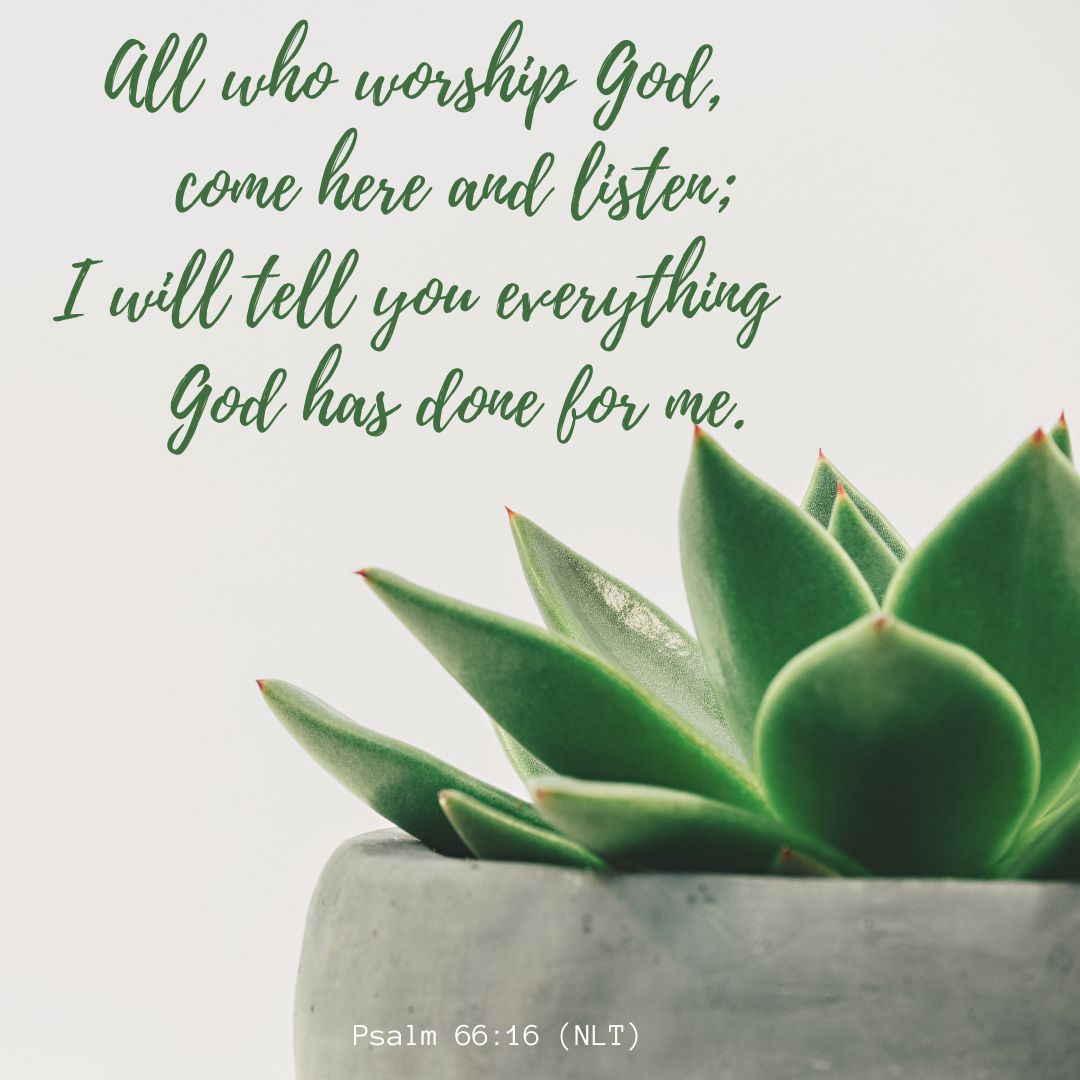
I think the psalmist sums it up pretty eloquently in Psalm 66:

As witnesses, we attest to what we have seen and experienced God doing. In this way, we join the great multitude of saints who have gone before us, proclaiming the love and grace of Jesus Christ.

Blessings and Peace,

Sara