Still A Time for Wonder

I laughed this morning as I read this post from a few years ago…because we’re just a couple of days from Christmas and everything in the first paragraph is still true! It’s like my life spins on one endless loop…I’m creating traditions where I don’t even know it. These words from Malachi were a good reminder for me just when I most need them, and it’s my prayer that they will be for you, too.

And thank you, for engaging in this faith exploration journey with me–for showing up in this space, even when it’s not regularly scheduled programming. I appreciate each of you, and wish you a very Merry Christmas whatever it might look like.

Sara

Today, we find ourselves entering the home stretch of the Advent season. Christmas is in two days and, per usual, I am in manic mode. There are gifts to finish purchasing, stockings to stuff, menus to plan, and goodies to bake. In all of my self-inflicted hustle and bustle, I sometimes forget to pause and reflect on why we celebrate Christmas in the first place. Holidays can easily devolve from celebrations to chores if we’re not careful, and there are times I have teetered on that ledge–or nose-dived right off it!

So now, I’m reflecting on the writings of the minor prophets: specifically, the books of Haggai, Zechariah, and Malachi. These three prophets lived and worked in the post-exilic period, after the Israelites had returned from Babylon. There was a lot of work to do–the land was in ruins. So this group devoted themselves to putting the pieces of their nation back together. It was busy work and, as happens in the midst of busyness, the people were neglecting God again. The prophets were there to remind them that, although the work of rebuilding the nation of Israel was important, most important was their continued faithfulness to God and his law. Kind of like our to-do lists, right?

And yet, I have found, that when we set aside our “must…keep…pushing…through” items and focus our souls on God, he shows up in such unexpected and remarkable ways that we can’t help but, as the hymn proclaims, stand in awesome wonder. Last year, about this time, a moment of awesome wonder came in my kitchen as I was sitting on the little wooden step stool my husband’s grandfather made long ago and which has become my Bible time stool. I was reading through the book of Malachi. Like his contemporaries Haggai and Zechariah, Malachi was urging the people to remain faithful to God, and chastising them for prioritizing other tasks and only giving God the left-overs of their daily lives. But Malachi was also speaking beyond the present, prophesying a time to come when God would judge between the faithful and the faithless, setting aside a people to call his own. Chapter four of Malachi ends this proclamation:

#saramsnyder.com

I quickly turned the page to see what would happen next, and was flummoxed to discover that there were no more words. What?! I thought to myself. That’s it? Truth be told, there’s one more verse–it says God will come and strike the land with total destruction. (Malachi 4:6) Quite the exclamation point! But I want to focus on the proclamation–the promise of Elijah before the day of the Lord’s arrival.

As I flipped ahead through the next several pages of historical commentary in my Bible, somewhat disgruntled by the lack of resolution on the author’s part, it dawned on me…Malachi ends abruptly because the story’s not done. Flipping quickly to the book of Matthew I sat, stunned, as I looked at the words before me. For the first time ever, I was awed, not by God’s word, but by a genealogical list of names.

Normally, when it comes to biblical genealogy, I just skim through it. But what stunned me, what awed me, weren’t the names themselves, but the fact that God had been continuing the story for generations, even after the prophets in Scripture had gone silent. Malachi spoke of the coming of Elijah in 430 B.C., and in the first-written synoptic gospel around 60 A.D., we have John the Baptist, an Elijah-like figure, living in the Judea wilderness and preaching a gospel of repentance in preparation for the coming of the Lord.

The final word in the Old Testament is a promise of the Lord’s coming. Then there’s silence. Time moves on. One generation gives way to the next. Nations rise and fall. Yet the minutiae of life keeps moving, like a time-lapse video, different figures blurring together as they move in an out of the same scene. Years pass…hundreds of them in which people are born, in which they live and laugh and love and cry, in which they die and are laid to rest with all of those who have gone before. And the Earth keeps turning.

It’s quiet. It’s ordinary. Until one day, in an ordinary time in an ordinary place, an angel delivers a message to a young man and a young woman that will change everything. While many people had long ago stopped expecting God’s promises to be fulfilled, God hadn’t forgotten. From Malachi to Matthew (and Mark and Luke) God had a plan, and what we celebrate at Christmas is the fulfillment of that plan.

#saramsnyder.com

This, then, is what fills me with awe. That God came in a moment when it was least expected–in a time when many had likely written off his promise of a messiah as a myth or legend–a story of hope to be shared, but not really to be anticipated. God continued the story…for thousands of years! And it’s a story he’s continuing to write–his words etched into the hearts of all those who love him–his promises yet to be fulfilled.

As the shepherds did on a night long ago, I stand (or sit) in awesome wonder of God’s work. I’m overwhelmed by the depth and breadth of his faithfulness. For me, this Christmas is about hope. The hope that God is faithful, that all of his promises will come to fruition in his time and in his way. God never gives up. He came when everyone least expected it, and in a way that no one could have foretold.

My prayer for you as we enter the Christmas season is that you, too, will have an experience of God that leaves you standing in awesome wonder. Are you looking? Are you waiting? Fear not! God will come.

Blessings and Peace,

Sara

The Reason I Sing

This is a repost from a couple of years ago…but it’s still true. Keep singing, my friends! And Happy Thanksgiving.

For several days this fall, I awoke with Phil Wickham’s beautiful hymn “Reason I Sing” playing through my head. If you haven’t heard it, take a listen here. I remember one morning in particular, when I was standing on the front porch watching the puppy run amok. The light was still new–you know–that happy pale yellow that makes everything look like an Instagram pic, and the sky was that perfect cerulean blue that only comes when summer is waning into fall. I remember looking at our bushes–which are big and unruly and always make me want to grab a shovel and start digging them out, and humming the chorus of Wickham’s song, when I had the unmistakeable awareness of the presence of the holy diffusing itself all around me.

Before you get all excited about some modern-day burning bush story that ends with me uprooting my family and heading to Egypt, let me clarify that I didn’t see my bushes on fire (though if they HAD been…never mind). No, in that moment of holy hello the overwhelming feeling that bubbled up inside of me was gratitude. I began thinking about all of the reasons I had to sing: breath in my lungs, a roof over my head, family peacefully slumbering inside, good friends to share the journey with, food on my table, work that I love….but mostly, that there is a God who created all things, who is full of love and mercy, and who calls me his own. And so, in that moment, the song I had awoken singing became a prayer of thanksgiving to the One who calls me beloved.

Gratitude is a powerful thing. I’m not talking about the merely polite “thank yous” we dole out when someone holds a door, hands us a receipt, or refills our water. I’m talking about that deep-from-your-soul spring of praise that bubbles up when you realize that you are walking with a holy presence, and the very fact that He IS means you are blessed. Maybe not materially, maybe not in health, maybe not financially, maybe not in peace…but for sure in the secure knowledge that you are held by the One who created the heavens and the earth and who holds eternity in his hands. And that is our hope. And that is our joy. And that, Wickham writes, is reason to sing.

That’s not to dismiss the horrors of the world–of which there are many. My heart breaks for the people of Israel, Gaza, Sudan, and Ukraine, especially the children whose lives are being ripped apart by unimaginable violence. I ache for those friends who are in the midst of the valley of the shadow of death–whether it be a physical loss of someone held dear, the end of a relationship, or a sudden change in life’s circumstance. But the fact that there is pain and suffering in the world shouldn’t diminish our capacity for gratitude, or cause us to cease lifting our voices in praise. On the contrary, I think, as God’s people, we are called to stand in front of that yawning pit of darkness and to fight it by lifting our voices together in a song of praise to the one who will make all things new.

Being grateful for what God has done in our lives doesn’t mean we’re ignoring the pain….it just means we’re choosing to put our hope in something more than that which can be found on Earth. And we know where that hope leads. It carries us to eternal joy, which is so much more than temporal happiness.

So this week, as we gather with loved ones to share a meal in a season meant for giving thanks, let’s lift our souls in songs of praise to the one who journeys with us, faithfully holding our hands as we navigate a road that can be broken, muddy, covered in boulders, hilly, and sometimes dark, knowing that he will lead us to where we need to be.

Blessings and Peace,

Sara
The Practice of Persistence–Coffee Edition

Coffee…rich, aromatic, sharp, and revitalizing…is one of my favorite things and, quite often, the reason I get out of bed each morning. According to legend, coffee was always there–we just didn’t know it until a young goat herder walking his livestock along the Ethiopian plateau stopped alongside some berry bushes and let his herd chow down. The goats began dancing and frolicking soon after, so the young goat herder decided to sample the berries, too. After experiencing a similar boost in energy, he shared the berries with some drowsy monks who used them to stay awake during nighttime prayers, and then the monks cashed in on the buzz the berries created.

There are many ways to enjoy coffee, but as self-proclaimed coffee snobs, my husband and I prefer the pour-over method–using freshly ground beans, of course. Coffee-making has become a sort of ritual for me, as I go through the same steps each morning to savor my one, glorious, cup of joe. The pour-over method is not quick. You have to heat the water, grind the beans, place the filter, and then pour the water slowly and methodically over the ground beans.

Making coffee this way can seem interminable–especially when I’m really sleepy–and my arm often gets tired from holding the goose-necked kettle over the glass carafe, though I tell myself it’s an exercise in strength-training. As the coffee blooms, it’s aroma rises and wafts around me. This is when impatience sets in, and I often find myself tipping the kettle too far in an effort to speed the water’s flow, resulting in a spill that I then have to clean up. Or, I attempt to pour my coffee before all the water has seeped through the filter, leading to a sludgy mess in and around my cup.

Often, as I’m working through this practice of patience, I think of all the labor that went into my coffee–not mine, but the many hands that brought the beans from far-off fields to my kitchen–and I take a moment to give thanks for them. On my best days, this ritual reminds me that I am a small part of something much bigger, that I am connected to people I will never meet, but whom I depend on each day. And when I let impatience have its way and make a mess, I am also reminded that God is never in a hurry. All of his work takes time, and its usually a lot longer than we’re willing to wait.

We live in a world of NOW, focused on the immediate rather than the long-term, but that’s not who God is. From the beginning, God had the eternal in mind, and when it all went sideways, he remained patient, letting his plans unfold in their proper time, and ensuring that each of the players in those plans were truly ready for the job God was giving them.

Consider David. He was just a child when Samuel anointed him God’s chosen king, and yet it would be years before he actually ascended the throne. David wasn’t ready to lead, and the people of Israel weren’t ready for his leadership. It took time (and a lot of running from a murderous king) before this man after God’s own heart was ready for the task God had called him to. And even after he’d achieved what God had designed, there was still a lot of soul-work to be done, and many more periods of waiting. In fact, “How long, O Lord?” becomes a common question throughout many of the Psalms attributed to David. Waiting is hard…especially when it feels like the world around you is falling apart. We, too, ask “How long, O Lord?” And often, the answer is “wait.”

Yet something important happens in the waiting…if we let it. Just as the coffee blooms and becomes fragrant as I pour the water over the grounds, so our souls expand and flourish as God works within them to bring his plans to fruition. We learn patience in the waiting. We also learn surrender and acceptance, which can, ultimately, lead to contentment and peace, regardless of our circumstances. God never promised us a quick fix, or, really, even a fix. But he did promise us his presence, no matter how long the wait. And he did promise that our hope in him would never be put to shame, even if the road is long and hard. Each morning, as I go through my somewhat absurd coffee-making ritual, I remember that God’s goodness will come, and we will be all the more grateful because of it.

Blessings and Peace,

Sara

What to Do When the Zeitgeist is Grim

Recently, a meeting at work got strangely contentious. I don’t know why. We were discussing article ideas, and since many of our texts center on amazing animals, quirky places, and kids doing remarkable things, it’s generally a pretty genial experience. Except this day, it wasn’t. People seemed more on edge. They were cranky. And instead of embracing possibility, there were more “this won’t work” moments. I blame the zeitgeist. And the fact that it was late afternoon. I don’t know about anyone else, but my patience and creativity tend to wane after about 2 PM. Much like an EV, our brains can only go so far before they need a recharge.

Unfortunately, finding a recharge at the moment is a bit tough. There’s too much noise. From social media posts to news stories and hushed conversations between colleagues and friends, the mood seems more than grim–it’s kind of like everyone, everywhere is running around in circles screaming while the alien spaceship’s doors are opening and the cosmic ray is slowly brightening. We’re not thinking, we’re just reacting, and we’re not even reacting wisely.

To complicate matters even more, the definition of Christian has been thrown into the mix, with sides being taken and insults being lobbed across the void, which is the exact opposite of what Jesus wanted his people to do. Don’t get me wrong, the world is a mess. And I am deeply troubled by the actions leaders are taking against their people (and people in general) throughout the world. Most everything about how governments work (or don’t) run contrary to the teachings of Jesus, but Jesus didn’t come to set up an earthly government. He came to establish God’s kingdom which transcends it all anyway.

In considering all of this, I found myself longing for a face-face conversation with Jesus this week. “Just 10 minutes!” I begged God. “Just send him into my kitchen for 10 minutes so I can ask my questions and get some answers about what it means to truly be a Christian in the midst of this mess we’ve made!” I wanted to make sure I had it right.

Apparently, Jesus was busy. Or rather, God didn’t seem to think he needed to hang out in my kitchen in bodily form. Instead, he spoke to me in his usual ethereal manner–little wisps of understanding that swirl and coalesce into a feeling of conviction. And what was God’s response?

Do the work I’ve placed on your heart and leave the rest to me.

This has been a recurring theme between God and I over the years. I’m a big picture person, and so I want to see the end result. But God has shown me time and again, from career changes to personal conflicts and even my concerns for the world at large that my job–my only job–is to do the work he has placed on my heart for today and to let him figure out the big picture.

I can’t end hunger. I can’t stop bombs from falling. I can’t cure cancer. I can’t stop grief. I can’t make people do the right thing. So, what can I do?

This morning, it occurred to me that I can live joyfully. Instead of propagating hate and vitriolic discourse, I can simply choose to embrace the gift of a new day and live in gratitude for what is before me right now.

Paul tells the Philippians, who were living in their own grim moment, to rejoice always. God had called the people there to engage in his work–to proclaim the Gospel and to do good. Do that, Paul says. And do it joyfully. God will take care of the rest.

That’s not to say that we don’t engage with the world–that we bury our heads or adopt the practice of toxic positivity. But I think, as people of Jesus, we can engage with the problems of this world in a much more constructive way. We can do what Jesus did. We can go out into our communities. We can see others. And we can do what we can to make their lives better. We can look on others with love and tenderness. We can show compassion. We put down the stones that we carry and offer an outstretched hand. And most of all, we can have faith in the fact that God is NOT done yet!

So, where is God calling you to work today? What story is he writing on your heart? Focus on that. Give thanks. And trust. The darkness might feel deep, but dawn will come.

Blessings and Peace,

Sara

What is a Christian?

Recently, I listened to a speech by a US Senator titled “What is an American?” In this senator’s framework, the definition of American was limited to White Anglo-Saxon Protestants (WASP) descended from Puritans and rugged frontiersmen who, apparently, tamed a continent and saved humanity. And if you can trace your lineage to one of these folks, you’re in. But if not, then America’s not really for you.

The speech bothered me, in part because it was filled with nationalist tropes and built on a mythos that was historically inaccurate, and discounted the contributions of millions of other Americans. It also bothered me because I know many Christians who applaud such ideas, and I don’t think we should. Which leads me to wonder: “What is a Christian?”

As I was pondering and praying, I read Ephesians 2–the second chapter of Paul’s letter to Gentile believers in which he outlines the crux of our faith: You are saved by God’s grace and have become an heir to his kingdom through the sacrifice of Jesus Christ alone. There were no ancestry lists to cross-reference, no list of deeds that had to be submitted and verified. You didn’t have to pay dues to join up, and you didn’t need to pass a test on Mosaic Law. The people of the Ephesian church were in because of the sacrifice of Jesus Christ, and no person and no circumstance on Earth could change that.

In essence, a Christian is someone who has accepted the grace offered by God through Christ and who seeks to live according to Christ’s teachings. It’s pretty simple, really. And Jesus simplified it even more when he said that all of the commandments boil down to two things: Love God; Love others. We’re the ones who overcomplicate it.

We draw boxes around church membership and make denomination labels. We establish rules and church laws and make judgements about who is in and who is out. The earliest churches did this, too, which is why Paul wrote so many letters. Because God’s house is big, and there is always room for one more.

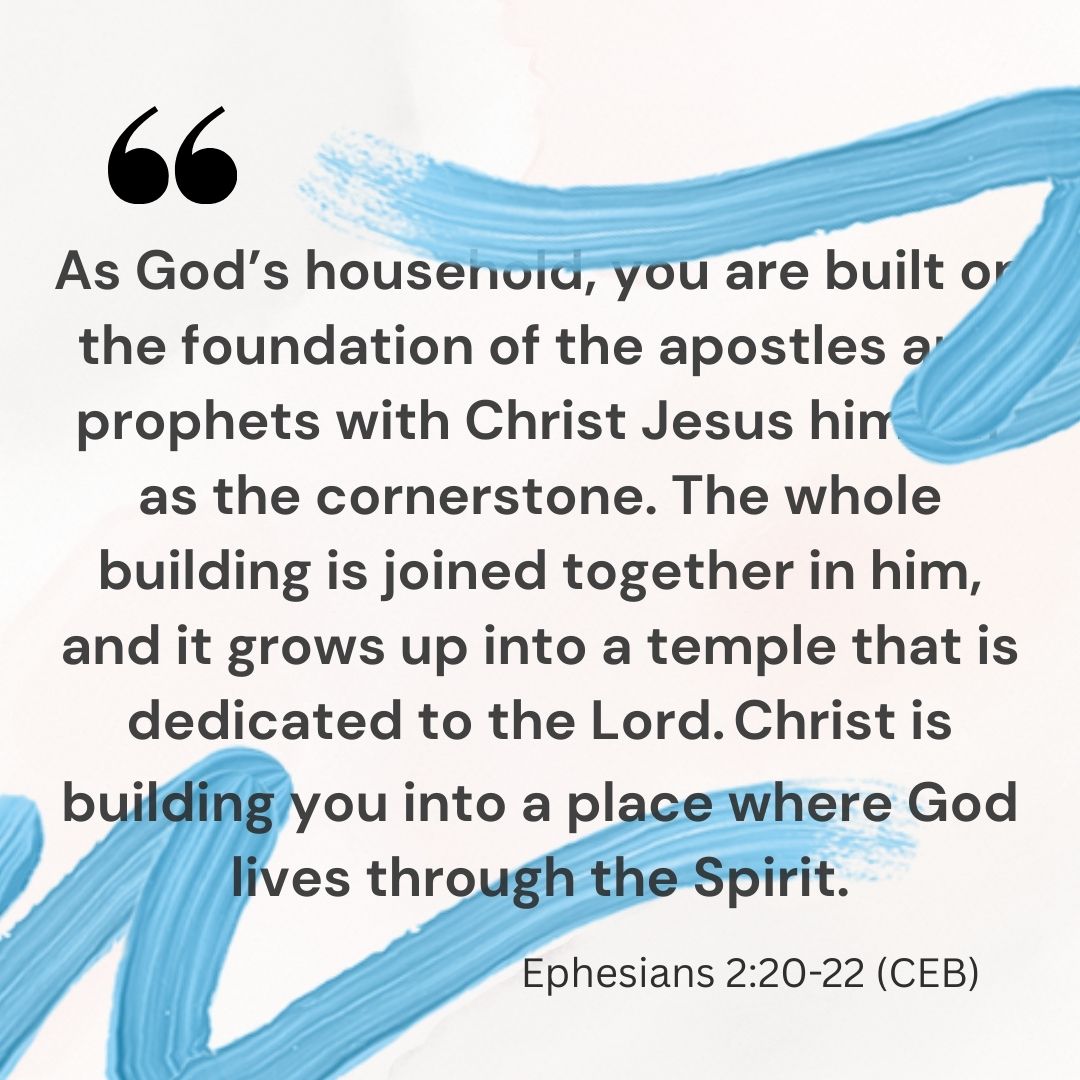
This is what Paul tries to explain to the Ephesians in 2:17-19:

God brings people of different backgrounds together. Paul states that God proclaimed peace to those who were far away (the Gentiles) and to those who were near (the Jews,) and then he says, “Guess what? You’re all related now!”

But there’s something else Paul says that we can easily miss, and it’s huge. Paul writes that because of God, both Jews and Gentiles were citizens of God’s kingdom, which in ancient Rome, would have carried a lot of weight. It was hard to gain citizenship in ancient Rome. Generally speaking, you were either born into it, or you paid a lot of money for it. And citizenship mattered–a lot. There were many rights and privileges afforded to Roman citizens that no one else had, including the right to legally marry, give your children an inheritance, vote, own property, have a fair trial, and not be subjected to torture or crucifixion.

So, when Paul writes that everyone who has been saved by grace is a citizen of God’s kingdom, he means that they ALL had equal rights and privileges through Christ who joins people together, regardless of their earthly citizenship, and that was a profound contrast to the political status quo.

However, Paul hasn’t dropped the mic just yet. There’s more…because with God…there’s always more.

This image reflects the beauty and glory and love of God. He brings people from near and far together, and with Christ as the cornerstone and the apostles and prophets as foundation, we become a living embodiment of the one true King.

Several years ago, my husband and my parents and I were touring Westminster Abbey in London. A public communion service is held each day at noon, and my husband and I decided to take part. It was a surreal moment, sitting beneath the vaulted ceiling of a nearly millennial-old church and reciting liturgy that the faithful have been engaging in for even longer. But what gave me chills was when we said the Lord’s Prayer, because suddenly, I heard it being offered in several different languages at once. People prayed in French and Italian, Korean and Spanish, Dutch and Hindi. It was the first time I’d ever experienced the church universal, and it opened my eyes to the absolutely awe-inspiring wonder and beauty of God.

God’s kingdom isn’t relegated to one nation alone; rather, it encompasses the world. And each of us who calls ourselves Christian becomes part of that world-wide church. We might quibble over “trespasses” vs. “debtors”, debate the theologies of Calvin and Wesley, and even argue over juice vs. wine. But in the end, Paul shows us in Ephesians that we are one body–a living temple–fused together through Jesus Christ. And there is room for us all.

Jesus said that we cannot serve two masters, Either you will hate the one and love the other, or be loyal to one and have contempt for the other. Of course, he was speaking of wealth, but I think he could be speaking about politics, too. Do we worship God, or our political ideologies? There are those in many countries who would have us believe that our true identity lies in nationality alone, and that each of our respective nations is only open to a select group of people who prove can prove their worth. And maybe they are…I don’t know. But it’s a premise I reject.

God’s kingdom, however, is open to all who wish to enter, so long as we are willing to accept his gift of salvation. There is nothing to prove. But there is much to do. God longs to establish his kingdom here, and he wants us to help build it. Yet we can only do that if we’re worshipping God alone, together, with all of his people.

Blessings and Peace,

Sara

A Confluence of Change

This weekend, we move our oldest son into college. I remember when I first went to college. My dad was a wreck. Like, a total hot mess wreck. He kept walking up to me, patting my head, and sighing. It was like I had some terminal condition, and I found it more cloying than charming. Of course, he didn’t talk about it–just stop, head pat, sigh. Finally, after I’d been at school a couple of weeks, I called to check in and we both sobbed into the phone until my mom got home and my dad tossed the call to her. It was absurd and funny, but now that I’m on the other side, it makes a lot of sense.

Launching kids is hard, and it seems completely unfair that it comes at that precise moment most of us are reaching mid-life. This confluence of change has left me feeling adrift. While I knew that my kids would grow up one day, and that I wouldn’t always be 28, it never occurred to me that this would take place NOW.

Over the past few months, I find a weird dichotomy taking place within. While I am highly cognizant of the passing of time and feel the need to “do the things” before the hourglass empties, I’m also spending more waking hours than normal reliving my past. Memories that I thought were just a few years ago, but I now realize were eons, flood my mind, and I find myself crying as I recall high school slumber parties, my childhood friends scattered around the floor in sleeping bags, talking, laughing, being young. There’s a literal feeling of mourning as I reflect on this time that was and will never be again–for those friends who are no longer with us, and also for the absolute freedom of standing in the middle of a wide-open road that beckons to the future with unlimited possibility.

As Katrina Kenison writes in The Gift of an Ordinary Day, “It is almost unfathomable that more than a quarter of a century separates me now from that teenage girl and her half-formed dreams. Harder still to believe that she’s grown up to be me, a middle-aged mother of two…”

Preach, sister. Yet even though we’re at the end of a season, I also feel myself at the precipice of a beginning, which can be just as confounding and heart-wrenching as the end. I suppose it’s because both end and beginning are part of the same movement–you can’t have one without the other. And while I keep looking for the beginning, I’m not quite sure where it starts. My husband is off on a new adventure–organizing, building, connecting within the community as he seeks to start a new mission. And while I’m whole-heartedly supportive of this endeavor, it’s not my dream. It’s not my beginning.

And so, I wait. And as I wait, God is reminding me, almost daily, that his plans require patience.

In Joshua, the promise God made to Abraham is finally fulfilled. Centuries have passed. People have come and gone. The world has moved on. God’s promise so long ago seems like the stuff of legend. It’s a good story, but not likely to be. But then, after Isaac and Jacob and Joseph and enslavement and freedom and Moses and the wilderness, God says it’s time to go. There is a promise to keep, and all is now ready.

God doesn’t care about time–at least, not in the way we care about time. He’s not going to hurry his plans to meet our desires because he knows what needs to be done and how it needs to be done and, sometimes, it takes a really long time. Look at the history of the universe–talk about playing the long game!

American writer Wendell Berry states:

I would argue that when what is known reveals itself to you, it is not by chance, but by God’s beautiful infinite design. And it comes when God is ready.

Blessings and Peace,

Sara

When God Says, “Umm…I Didn’t Tell You To Do THAT”

This is a post from 2019, but it still rings true today. Sometimes, I want things to move so much more quickly than they do. I miss God’s rhythm, and I make a mistake. But God doesn’t just toss me out like a bad painting–he keeps his brush moving to create a masterpiece!

Proverbs 4_2 CEV

Awhile ago, I went with my Bible study group to a painting class. I have to tell you right now, art and I are not friends. As one artist sagely noted while grimacing at my misguided attempt to draw a beach scene, “Well, you have other gifts.” Truer words have never been spoken, and yet, I signed up for a painting class anyway. It was a lovely scene,  a graceful willow overhanging a still pond…dappled sunlight falling lightly through the leaves. I took one look at this portrait of sublime serenity and thought, you’ve got to be kidding!

90 minutes into the class, I was ready to be finished with the entire project. I had used all of my mental reserves to painstakingly craft a semi-shaded grassy embankment from which my graceful willow would spring. But, there were so many details involved in painting grass that I just did not have the energy or ambition to do anything else. And so, when it came time to create the wispy willows of the willow tree, I didn’t do my best. To be fair, I thought the instructor said to make tiny dots along the canvas for the willow branches. However, I was restless and tired and didn’t want to be paining willow leaves all night. So, instead of clarifying the instructions and copying the proper form, I did this.

Willow Branch

When the instructor came over to inspect our work, his response was less than encouraging. In fact, when a friend repeated what we thought his instructions were, his response was, and I quote, “I most certainly didn’t tell you to do THAT!” Instead of wispy willow branches lazily skimming the surface of a pond, I had Medusa’s head on a purple tree trunk. In my rush to be finished with a task that was tiring, I ended up with a useless painting I’m too embarrassed to even throw into the trash.

As I contemplate my Medusa-willow, I can’t help but reflect on the instructor’s exclamation, and my own heedless desire to forego process for finished product. In my rush to be done, I did a poor job, and the instructor made it abundantly clear that my work should in no way be considered a reflection of his teachings.

How often, do you think, we Jesus followers rush through the process of living by faith and mistake or misrepresent Jesus’ actual teaching? Do you feel like, sometimes, Jesus is echoes the  sentiments of the art instructor? Does Jesus ever say to us, “I most certainly didn’t tell you do to THAT!”?

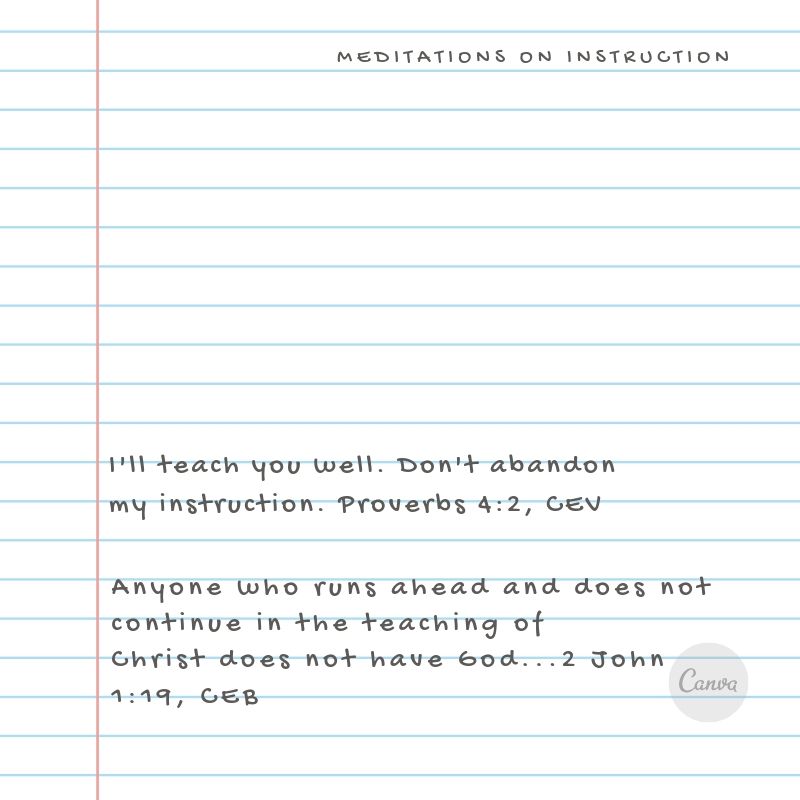
If we’re honest, I think the answer is a resounding YES! The truth is, we all sin and fall short of the glory of God (Romans 3:23). The process by which we grow in our faith is long–a lifetime–and requires a lot of focus, a lot of effort, and a lot of intentionality. John says that when we run ahead of Christ, then we, in essence, run away from God. When we run ahead of Christ, we miss important details. The masterpiece of God’s creation within us becomes a bit of a mess. And, while God can absolutely redeem and restore it, wouldn’t it be better if we just followed instructions the first time? Proverbs tells us that God will teach us well, but we have to follow those teachings. But, how do we live that out? How to we go about living this Jesus life on a practical day to day basis?

First, I think we have to bathe our decisions in prayer, both the large and small. Most of us understand the need to seek God’s wisdom when it comes to major life decisions. But, I believe that seeking God’s wisdom in the small decisions can help us to better hear God’s voice in the midst of those major decisions. For example, sometimes I ask God if I can have a cookie. I know, it sounds crazy. But, here’s what I’ve found. If I go to God in prayer about a cookie, then he and I can have a conversation about the nature of the desire for the cookie. Is it really just about a cookie? Or is it about meeting a deeper emotional need? Going to God about a cookie can lead to deeper self-reflection and awareness. Moreover, if I can train myself to seek God for something as mundane and non-life-altering as a cookie, then I’m prepared to go to him when something truly life-altering comes my way.

Second, we need to clarify information by regularly reading Scripture. Scripture is God breathed. In the stories of faith, we find wisdom and guidance for our own faith journey. God’s Word is a lamp for our feet; a light for our path (Psalm 119). God’s Word shows us how to live. It reminds us that when we’re really frustrated at inefficiency in a place of business, that those serving (or not serving) us are children of God whom we are called to love and snapping at them will not improve the service (or lack thereof). God’s Word reminds us that we are to have compassion for the oppressed, not condemnation.  We are to seek justice, even when the world seems unrepairably unjust. God’s Word is instruction, and that instruction leads us on the pathway to life.

And so, my friends, this week I challenge you to seek God’s input. Seek his wisdom in matters both big and small. Then,  follow his instructions, even when you really just want to be finished with the whole process.

Blessings and Peace,

Sara


The Complexities of Love

Sunset and Trees Landscape Good Evening Quote

Several years ago, I remember getting a phone call right before dinner. I was juggling plates, loading up food, and sniffing the milk to make sure it was drinkable when I glanced down at the caller ID and immediately sighed. Ugh…what now? 

The person calling me was someone I had been ministering to for awhile. This person was trying to get back on the path that leads to life, but it was a very rocky road, and I simply did not have the time nor desire to be a hiking guide. Instead of embracing the opportunity to show the love of God to someone in need, I instead chose to ask God why he insisted on brining people into my life who needed to be shown that love in the first place. With my best impersonation of Alicia Silverstone’s Clueless performance, I rolled my eyes to the sky and said, “Like, you know, God, I to-tal-ly have my own life!”

Of course, God responded in equal measure and I’m pretty sure I heard him say, “Are you serious right now?” I put down the plates and picked up the phone.

Sometimes, love is hard. If I’m being honest, I don’t always want to put out the effort to love. Love is messy. Love is complicated. Love is uncomfortable. Love makes you vulnerable. Love takes time. Love requires intentionality. Love is unpredictable. Love is hard. Why didn’t Paul say any of that in 1st Corinthians? I suppose no one would want to hang it on their living room wall…

It’s true though…real love is work. It’s so much easier to talk about it than to do it. Take my eldest. He’s come up with about 1000 different screenplays over the years that he plans to put into development one day when he sets forth on his moviemaking life in LA. But, put a pen and paper in the guy’s hand and he suddenly has something much more pressing to do than work out the details of a script that is so much more fun to just talk about. Scriptwriting is a lot of work. Talking about a concept, pretty easy.

The thing is, Jesus was pretty clear about the easy life, and it’s not for us would-be Jesus followers. Jesus said, if you want to follow me, you’d better be ready to work.

Then Jesus said to his disciples, “Whoever wants to be my disciple must deny themselves and take up their cross and follow me.

Then Jesus said to his disciples, “Whoever wants to be my disciple must deny themselves and take up their cross and follow me.-2

Jesus says that we can’t truly follow him unless we’re ready to give up ourselves and focus on others. We have to put aside our own ambition, our own wants, our own plans, our own will, our own perspective at times in order to put love into action. Because our job is to follow Jesus, and Jesus doesn’t always take us on a beach vacation. Where Jesus goes, life is rough. Where Jesus goes, people are broken. Where Jesus goes, shadows threaten. But Jesus makes rough places plain. Jesus heals the broken spirits. Jesus casts out the darkness with the light of his love. And my friends, he invites us to follow him on this journey.

I’m ashamed to admit that when it comes to putting love in action, I often don’t want to follow. I don’t want to give up my time, my energy, or my dinner plans to follow Jesus somewhere or to someone who makes me uncomfortable. I don’t want to see the broken, or walk in the shadows. But then Jesus says, if you can’t put my love into action, then you can’t really follow me. And I want to follow Jesus. I want to follow Jesus because he is the way, and the truth, and the life.  I want to follow Jesus because I thrive in his presence. I want to follow Jesus because he gives my life purpose. So, I need to work more on talking less and walking more. I need to put Jesus’ love in action, so that others can know how great his love truly is.

Blessings and Peace,

Sara

Small Ties That Bind

This morning, I got out of bed and made my coffee. I said a prayer over my cup–my morning coffee prayer– asking, as I do each morning, that God will bless all of those whose hands have led to the cup being placed in my hands. I use the same phrases, call to mind the same images, as I go through the life cycle of a coffee bean. It’s a small ritual, but it’s one that grounds me in a big way. It reminds me that I am just a small part of something much larger, and that what I have and enjoy is not mine alone. Others have cultivated and nourished and shaped it, too, so at the end of its journey, when the coffee is poured into my cup, I feel a profound sense of gratitude for that first rich sip.

My coffee prayer is a ritual–a solemn rite that I engage in repeatedly, intentionally, in the same way, over and over again.

Often, when I think of ritual, I think of those big acts of worship that we engage in on Sunday mornings: communion, the Lord’s Prayer, the Apostles Creed, the Gloria Patri, the Doxology. And if I’m being honest, sometimes they get a little old (Apostles Creed, I’m looking at you!). If you asked me what I thought about rituals, in general, I would roll my eyes and give you my best 80’s Valley Girl “Uck–as IF! They’re so booooring!”

But this morning, as I pray over my coffee, I realize that I’ve got rituals all wrong. Rituals aren’t rote tasks that we complete on autopilot just because it’s something we’ve always done. Rather, they are intentional acts of worship that bring the divine and the earthly together in sacred communion. In going through the motions of ritual, we remind ourselves that what we are part of something bigger, something nobler, something stronger and more lasting than our little lives. Ritual is a beautiful mingling of past, present, and future. Our words and actions are familiar, having been taught and practiced over time, but they speak to us anew where we are right now, and they give us hope and stability for what is to come. There is comfort in ritual. And we create it, even if we think we’re opposed to it.

How do you order today? What are those intentional practices you engage in that give your tasks meaning? Maybe it’s a special prayer you say before each meal. Perhaps it’s going to the same space each day to meditate or read God’s word. It could be an early morning walk as you gaze at the wonder of a new day opening up, or a late night glance at the stars holding court in the night sky.

We all create rituals, and these small moments of the sacred infused into our day are the ties that bind us to God’s beloved kingdom. Rituals, whether practiced corporately or alone, build community. In the Gospels, we see Jesus pausing throughout his missionary journey to engage in rituals. There was the Lord’s Supper on the night before he was arrested, there was the reading of Scripture in the synagogues, and the mixing of mud and spit before a healing. Though Jesus’s ministry was itinerant, it was grounded by rituals both big and small. And it was the practice of those rituals which helped the disciples recognize Jesus upon his resurrection.

Rituals don’t have to be huge. We can practice them simply, quietly, in the midst of our busy days. They are a moment, however brief, to feel God’s loving presence, and to know that we are not alone.

Blessings and Peace,

Sara

New Year, One Word 2025: Openness

Last night, as we were closing out 2024 with good friends around the table, sharing stories, food, and laughter, my husband posed this question: What are you most looking forward to in 2025?

These kinds of questions always stump me. They require some form of planning, which I’ve never been particularly good at. 2025 will definitely be a year of change in the Snyder household, as our eldest graduates high school this spring and begins to make his way into the world. And though I am excited to see what his future holds, I can’t say it’s what I’m most looking forward to this year. And so, I’m back to the original question, and my honest answer is simply this–I’m looking forward to seeing 2025 unfold and am open to all of the possibilities that it brings.

While it might seem blasé, or even a little trite, it’s the space in which I find myself on this New Year’s Day, and it truly fills me with excitement. I love looking into the future with no predetermined expectation or intention, because that, in my experience, is where God works best. God rarely looks at our calendars and picks a blank date in which to schedule a visit. Instead, he tends to throw our carefully planned itinerary out the window and invites us to step into the chaos of creation with him. There is so much possibility in that, if we are open to it…which leads me to my focus word for 2025: Openness.

I want to be open to all that God seeks to do in our lives this year. I want to be like the lake trout that I read about in Gayle Boss’s book of Advent reflections titled All Creation Waits. As Boss writes, the lake trout deposits her eggs among the rocky shoals of Lake Michigan and swims on, having done all that she can do while the eggs wait, “vital but dormant” until winter ends. Like the trout, I want to plant seeds this year that, while they might lie dormant for a time, will burst forth with life when God says it should be so. I want to be open to the fact that, while things might not go exactly as planned or hoped for this year, God is still doing a new thing, and, as the psalmist writes:

It always brings me immense comfort to reflect on the promises of God which have been fulfilled. Throughout Scripture, and in my own life, I see the goodness of his love manifested in the fulfillment of his promises. When God says he’ll do something, he does it. Though, admittedly, he and I often have a profoundly different sense of timing. Where I often respond in haste, God takes his time. He sees the bigger picture and, like any great artist, is willing to let his masterpiece unfold slowly, one brushstroke or typed phrase at a time.

For me, being open to what God is doing means waiting and watching. It means listening more and thinking before responding in situations. It means not rolling my eyes when new initiatives come around at work, and not bristling with indignation when someone suggests a change to how we always do things at home, or work, or church. Openness, for me, means being willing to put forth ideas, and then to let those ideas go if someone has a better one. It means connecting with others, even if I’d rather stay home and read a book, and engaging in tasks that I don’t like but that make a difference to someone else. Above all, openness means actively seeking those places where God is working and being willing to work with him, even if the work wasn’t something that I had planned or initiated or even find interesting.

I have no idea what 2025 will bring….there will be laughter, and likely some tears; there will be new beginnings, as well as bittersweet endings; people will come into our lives, and others will depart; we will have adventures, both planned and unexpected, and we will be faced with challenges both big and small. But if we are open to God’s working in our lives, if we are willing to put in the work to plant the seeds rather than just partaking of the harvest, what wonders might we behold?

It’s a new year, and God is doing a new thing. Though the news might be bleak, though the hearts of some might be sad and the spirits of others might be shaken, though some might be looking to the new year with hope and a sense of promise, and others with trepidation, one thing is certain:

God’s not done yet.

2025 is open….are you open to what God will do within it?

Blessings and Peace,

Sara