Recently, I listened to a speech by a US Senator titled “What is an American?” In this senator’s framework, the definition of American was limited to White Anglo-Saxon Protestants (WASP) descended from Puritans and rugged frontiersmen who, apparently, tamed a continent and saved humanity. And if you can trace your lineage to one of these folks, you’re in. But if not, then America’s not really for you.
The speech bothered me, in part because it was filled with nationalist tropes and built on a mythos that was historically inaccurate, and discounted the contributions of millions of other Americans. It also bothered me because I know many Christians who applaud such ideas, and I don’t think we should. Which leads me to wonder: “What is a Christian?”
As I was pondering and praying, I read Ephesians 2–the second chapter of Paul’s letter to Gentile believers in which he outlines the crux of our faith: You are saved by God’s grace and have become an heir to his kingdom through the sacrifice of Jesus Christ alone. There were no ancestry lists to cross-reference, no list of deeds that had to be submitted and verified. You didn’t have to pay dues to join up, and you didn’t need to pass a test on Mosaic Law. The people of the Ephesian church were in because of the sacrifice of Jesus Christ, and no person and no circumstance on Earth could change that.
In essence, a Christian is someone who has accepted the grace offered by God through Christ and who seeks to live according to Christ’s teachings. It’s pretty simple, really. And Jesus simplified it even more when he said that all of the commandments boil down to two things: Love God; Love others. We’re the ones who overcomplicate it.
We draw boxes around church membership and make denomination labels. We establish rules and church laws and make judgements about who is in and who is out. The earliest churches did this, too, which is why Paul wrote so many letters. Because God’s house is big, and there is always room for one more.
This is what Paul tries to explain to the Ephesians in 2:17-19:

God brings people of different backgrounds together. Paul states that God proclaimed peace to those who were far away (the Gentiles) and to those who were near (the Jews,) and then he says, “Guess what? You’re all related now!”
But there’s something else Paul says that we can easily miss, and it’s huge. Paul writes that because of God, both Jews and Gentiles were citizens of God’s kingdom, which in ancient Rome, would have carried a lot of weight. It was hard to gain citizenship in ancient Rome. Generally speaking, you were either born into it, or you paid a lot of money for it. And citizenship mattered–a lot. There were many rights and privileges afforded to Roman citizens that no one else had, including the right to legally marry, give your children an inheritance, vote, own property, have a fair trial, and not be subjected to torture or crucifixion.
So, when Paul writes that everyone who has been saved by grace is a citizen of God’s kingdom, he means that they ALL had equal rights and privileges through Christ who joins people together, regardless of their earthly citizenship, and that was a profound contrast to the political status quo.
However, Paul hasn’t dropped the mic just yet. There’s more…because with God…there’s always more.
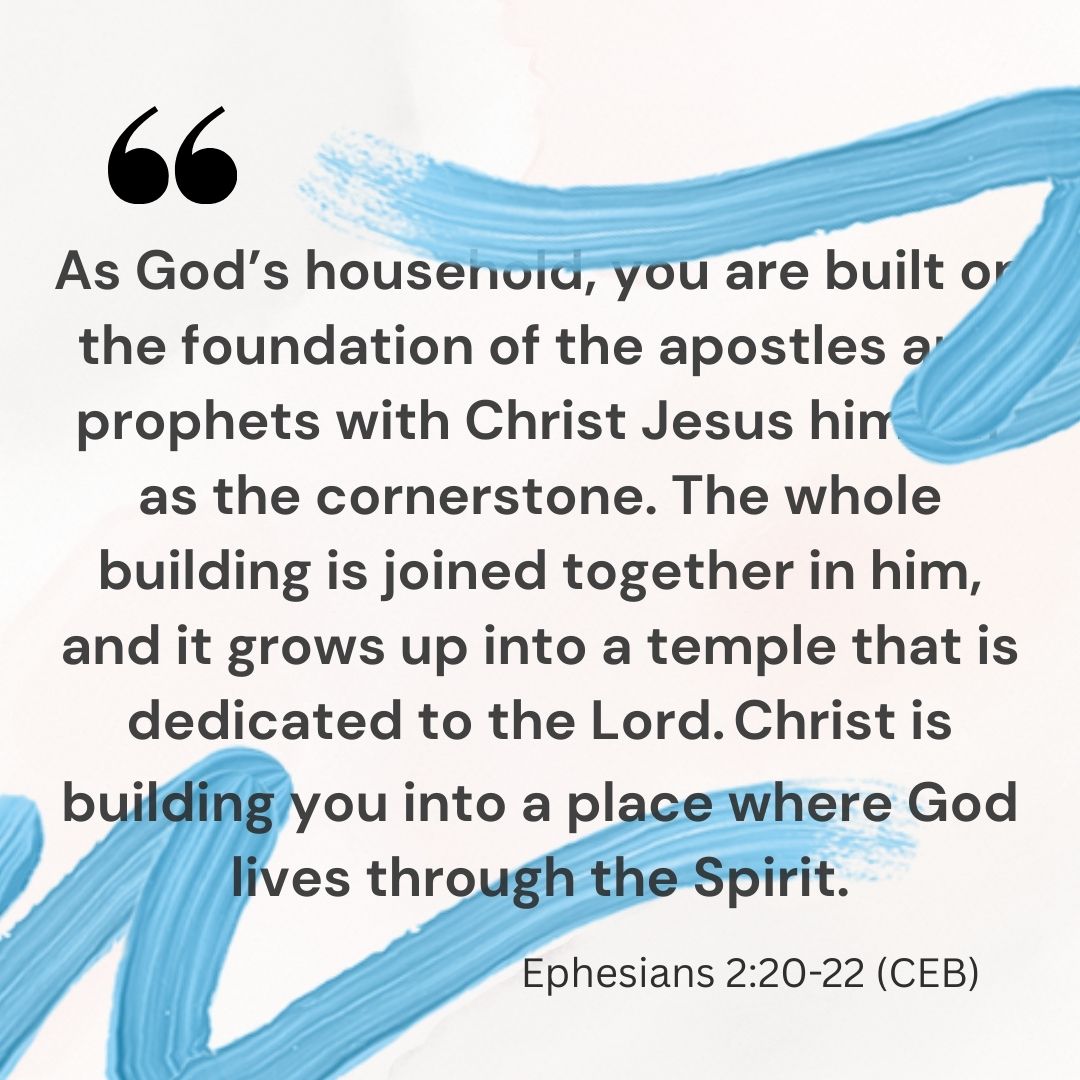
This image reflects the beauty and glory and love of God. He brings people from near and far together, and with Christ as the cornerstone and the apostles and prophets as foundation, we become a living embodiment of the one true King.
Several years ago, my husband and my parents and I were touring Westminster Abbey in London. A public communion service is held each day at noon, and my husband and I decided to take part. It was a surreal moment, sitting beneath the vaulted ceiling of a nearly millennial-old church and reciting liturgy that the faithful have been engaging in for even longer. But what gave me chills was when we said the Lord’s Prayer, because suddenly, I heard it being offered in several different languages at once. People prayed in French and Italian, Korean and Spanish, Dutch and Hindi. It was the first time I’d ever experienced the church universal, and it opened my eyes to the absolutely awe-inspiring wonder and beauty of God.
God’s kingdom isn’t relegated to one nation alone; rather, it encompasses the world. And each of us who calls ourselves Christian becomes part of that world-wide church. We might quibble over “trespasses” vs. “debtors”, debate the theologies of Calvin and Wesley, and even argue over juice vs. wine. But in the end, Paul shows us in Ephesians that we are one body–a living temple–fused together through Jesus Christ. And there is room for us all.
Jesus said that we cannot serve two masters, Either you will hate the one and love the other, or be loyal to one and have contempt for the other. Of course, he was speaking of wealth, but I think he could be speaking about politics, too. Do we worship God, or our political ideologies? There are those in many countries who would have us believe that our true identity lies in nationality alone, and that each of our respective nations is only open to a select group of people who prove can prove their worth. And maybe they are…I don’t know. But it’s a premise I reject.
God’s kingdom, however, is open to all who wish to enter, so long as we are willing to accept his gift of salvation. There is nothing to prove. But there is much to do. God longs to establish his kingdom here, and he wants us to help build it. Yet we can only do that if we’re worshipping God alone, together, with all of his people.
Blessings and Peace,
Sara
 Confessions of the Pastor's Wife