
When writer Michelle DeRusha announced last year that she was working on a biography about Martin Luther’s wife, my first thought was–“Martin Luther had a wife?” I am a self-professed history nerd (it was my minor in college) and although I racked my brain, I couldn’t remember any history book ever mentioning the fact that the father of Protestantism had a wife. History, as we know, is often written by those who hold the most power over it. And, in the Middle Ages, women were not the primary stakeholders of history.
That, however, is changing. DeRusha’s work paints a fascinating portrait of a couple drawn together in a wave of political, theological and cultural change who, hand in hand, helped to shape the Modern era. The Luther’s story is a compelling and thought-provoking peek into the heart of Christian marriage.
Katharina and Martin Luther: The Radical Marriage of a Runaway Nun and a Renegade Monk isn’t a dry historical tome, but rather a rich and vivid exploration of life during the Reformation that pulls the reader in and doesn’t let go. DeRusha’s prose brings these historical figures to life, so much so that when reading the book you feel as if you’re there with the Luther’s, listening and participating in one of Martin Luther’s famous Table Talks.
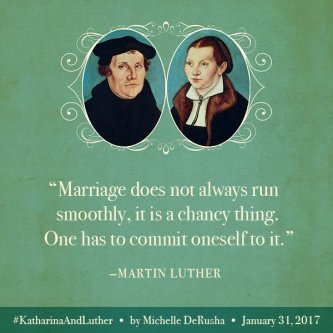
So, what makes this such a fascinating read? Well, let me give you a sneak peek.
Katharina von Bora’s story begins when, as a young girl, she is essentially sold to the church by her family. Paying for a daughter to become a nun was cheaper than marrying her off, so many girls like Katharina found their life preordained behind cloister walls. Katharina became a nun at the age of sixteen. During this time, renegade monk Martin Luther was making waves across the country with his talk of church reformation. Luther wrote and spoke passionately against the practices of the Catholic Church. He urged the church to turn back to the practices of Jesus as laid out in Scripture.
Inspired by these ideas, Katharina (along with 12 other nuns) planned a daring escape from the confines of their convent. Once free of the convent, Katharina had little choice but to marry. Martin Luther attempted to play match-maker for her, but his choices didn’t work. Instead, much to his initial bewilderment, Luther found himself compelled to take Katharina as his wife. In his eyes, this marriage was an act of Christian charity.
At the time, Luther hardly knew the tsunami like force he had brought into his quiet life. Katharina quickly proved herself to be an indispensable “helpmate” to Luther. She took over the family finances, became his literary agent, challenged his thinking, was doctor, nurse and pharmacist, gave birth to six children and adopted several others, took part in theological discussions around the table and became Luther’s closest friend, ally and confidant.
One could argue that Martin Luther would not have had such a lasting impact on the world had it not been for Katharina.
And yet, DeRusha’s book is more than just a history lesson. It is also an intimate and poignant (albeit nontraditional) love story that demonstrates the depth and power of Christian marriage. In Katharina and Martin Luther, we see Christian marriage as it should be; God-centered, selfless, equitable and full of grace.
To order Katharina and Martin Luther, click here. And, spread the word. It’s time this story was told.
Blessings and Peace, Sara





 My goal for 2017 is to spend some quality time in the desert. Like the ancient church fathers, I want to leave behind the immediacy of life and spend some time in deep contemplation. I want to ask hard questions and wrestle with complex answers. I want to engage in conversations that stretch my knowledge and expand my boundaries of understanding. I want to study the changes in the lake right outside my back door though every season of the year, marveling in God’s ability to create and sustain. I want to build relationships that are miles long and fathoms deep. And finally, I want to cultivate a life lived in peace.











 Jesus didn’t lead an easy life on earth. He wasn’t born into a wealthy or influential family. Rather, he came as the son of a carpenter. Jesus’ family felt the full impact of the Roman occupation of Palestine and were even forced to flee the country and live as refugees in Egypt for several years. As Jesus grew older, he didn’t have the advantage of a rabbinical education. Instead, he learned a trade. And when he began his ministry, he didn’t go to those who had money, power and influence. He chose to walk among the outcast, the poor, the sinful and the needy.






 Confessions of the Pastor's Wife