Pumpkin Moons

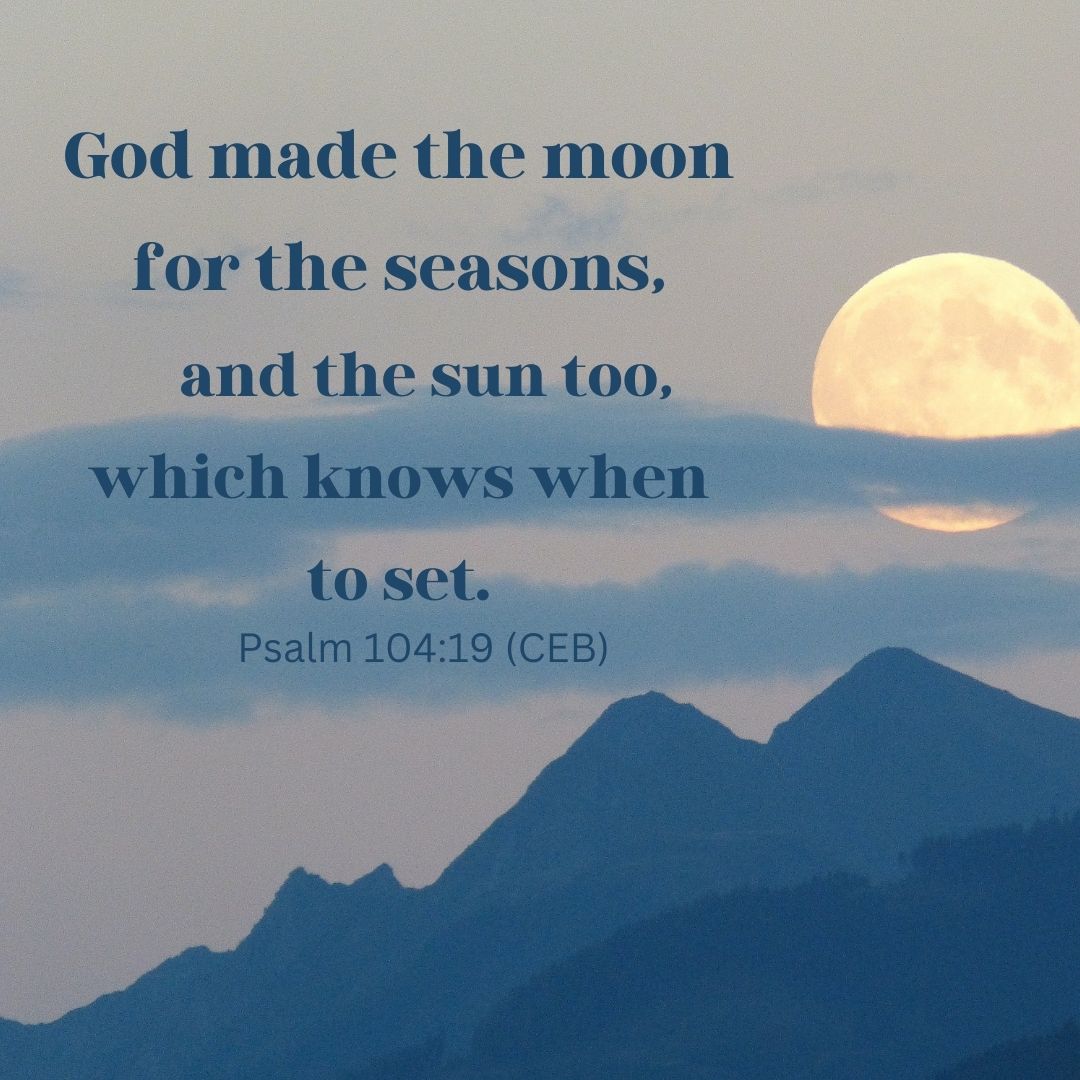
Last night, I saw a pumpkin moon. Well, I’m sure it wasn’t technically called a pumpkin moon, and it wasn’t actually last night because we were in the wee hours of the morning–but in my itchy-eyed newly yanked from dreams state, leading a giant horse of a puppy with an upset tummy around the yard in my bathrobe, the moon looked like a giant pumpkin in the sky. And it was cool. Though I was tired and annoyed and hot because it’s summer in Missouri, I paused for a moment to give God thanks for letting me see that remarkable moon (no joke–it was pumpkin orange!).

However, the next two times the pup woke me up I was not as grateful to be roaming the yard and gazing at the sky. Honestly, at one point, I thought about just opening the side door and letting her fend for herself. Raising this puppy has been exhausting–much more like caring for my children when they were toddlers than any other dog I remember having. We have moments of pure bliss, when she is cuddly and sweet and a marvelous companion. Then there are the other moments, when she’s jumping and nipping, or when you come home and see that she’s thrown a massive party in your absence, complete with special piles of mess you then get to clean up. In my worst moments I think: We should never have gotten another dog!

But then God sends me a message, like the quarterly email I got from our dog training place, where someone much more experienced with puppies than I am had the foresight to say: Enjoy the dog you have, even if it’s not the dog you envisioned it would be.

Well…that’ll preach. As I think about my life, I realize that this little nugget of truth applies on so many different levels. How many times have I thought that if only things were different, then I would be content. If my kids were more driven, or if I were more organized, or if we had a different house, or if we took more trips, or if I was more generous, or if we lived closer to family, or if I could just get one non-interrupted night of sleep.

I think many of us live on the “if only” side of life. We look around at the images others choose to share of their existence and think–that’s what I need to do in order to be fulfilled! We keep looking ahead to the next season and ignore the beauty God wants to show us through the season we’re in. We miss the pumpkin moons because we’re waiting for the sun to rise on a new day, rather than reveling in the miracle that the present day we’re living in is.

As I journey farther into middle age (another “if only”…), I’m realizing the importance of embracing the season I’m in, rather than wishing it away so I can get to something better. Because the reality is, there isn’t a better out there. We will never crest that hill or round that bend into our #livingmybestlife season because it doesn’t really exist. Life is a series of seasons, each with its highs and lows. And as God’s created ones, I think we need to embrace all of it as it comes, rather than seeking the “if onlys” of our imaginations.

The apostle Paul wrote a lot about contentment. By the time he was sharing his wisdom in the epistles, he’d learned to cultivate a life of peace (or, at least that’s what he said!). But Paul’s contentment was hard-won. He sacrificed the life he had built for himself in order to follow Christ. Paul gave up his hopes and dreams–his actual home–to travel the Mideast seeking to share the good news with others. He walked and walked, slept outdoors, encountered angry mobs, had his name slandered, was unjustly imprisoned, and wasn’t ever really accepted by the elite disciples. Paul likely had a long litany of if onlys going through his mind…but he chose to push them aside and find the wonder of what God was working through each season of his journey. Paul told the early church:

This week, I’m going to make a concentrated effort to follow Paul’s example. I’m going to shove away the “if onlys” that will invariably come to mind and, instead, look for something in this season for which I can be grateful. Today is all we are ever promised, so let’s not waste it wishing it would be something different. Instead, let’s choose to see the pumpkin moon and give thanks that we were awake to witness it.

Blessings and Peace,

Sara

Hanging By a Moment

It was a quick cut—a passing comment, really, that served as a glancing blow among preteen girls around a sticky Formica table in a crowded middle school cafeteria. Faces are now fuzzy, a kaleidoscope of teased hair and blue eyeshadow and jean jackets and Swatches. But the words are as searing today as they were more than 30 years ago when I was 12 and uncool and uncertain and unconfident. It’s funny how that shy awkward girl peeks out from time to time, a questioning presence from the past that asks me if despite the growth, despite the experiences, despite the successes, we might still be lacking. We sit together, hanging on a moment long ago, alone now at that long-gone cafeteria table, feeling…everything.

Moments—they are the focal points on which we paint our life portraits. Some make us cringe—those shameful moments that make us feel inadequate or undeserving or just plain dumb. Other moments are kinder, memories of love and joy and happiness that we cling to like a security blanket, filling us with warmth and gratitude. And then there are those moments that fundamentally alter the course of our lives—a great continental shelf that gives way, plunging us into a new world where life’s boundary lines are irrevocably redrawn.

I don’t know about you, but I often find that I get defined by my life’s moments. One negative encounter, one harsh comment, one piece of criticism, and I am cycling through every time in my life where I felt inadequate, or embarrassed, or just plain wrong. One amazing success and I’m suddenly content to stay in this space, to be confined to the safety of a present accomplishment, and never risk anything again. And yet, both of those tendencies are false narratives of who I am and who I was created to be.

The Bible is chock-full of people who could have been defined by moments. Moses killed an Egyptian and fled the country. David brought down his entire household when he coveted someone else’s wife. Saul stood by and encouraged a crowd to murder the apostle, Stephen. Jacob…well…let’s just say this patriarch of the faith had a LOT of moments that could have defined him. And yet, in the lives of each of these men, God was writing a different story. God didn’t let these moments define Moses, David, Saul, or Jacob. Instead, he used them along with a thousand other moments to tell his story of salvation and restoration.

The truth is, while our lives might be compiled of moments, we are not defined by them. Or rather, we should not be defined by them. It’s like pointing to one image on the Sistine Chapel and labeling it Michelangelo’s penultimate work. While beautiful, it was a paid commission, and not necessarily indicative of who Michealangelo was as a human being. Honestly, other than the chapel, David, and the Teenage Mutant Ninja Turtles, I couldn’t tell you anything about Michealangelo. In the same way, I couldn’t tell you anything about the speaker in the middle school cafeteria years ago, other than the fact that she happened to say something snarky that hurt my feelings when I was in SIXTH GRADE!

So, why do we hold onto moments like they’re the be all, end all of our existence? Why do we continue to cling to them as if they’re a lifeline, rather than the single strand of experience that they are?  Like the saints who came before us, God is writing a bigger story in our lives. It is a story made up of countless moments. There are moments that sparkle, and others that burn. There are moments filled with laughter, and others punctuated by tears. There are moments we are proud of, and others we’d just as soon forget. God wants each of these moments, the hard, the shocking, the beautiful, the mundane because they are part of the masterpiece he is creating in our souls. If we elevate one moment above all others, we distort the story he is seeking to tell—that we are a people redeemed and loved and created to do good things.

I don’t know what moments you’re holding onto, but I do know that God is ready for you to let them go—to move past the past and embrace the whole beautiful, messy sum of who God is creating you to be. Let God tell his story in you, and marvel at the wonder of his work.

Blessings and Peace,

Sara

The Charles F. Stanley Life Principles Daily Bible: A Walk and Talk with God

One of my favorite activities is taking a long walk outside, and I especially love it when my husband or a good friend tags along. These walk and talks are restorative to my soul in so many ways. A weight lifts, relationships deepen, I feel energized, and I can’t wait to jump back into the fray of life renewed and refocused.

This is what spending time with God should be–a chance to cast of whatever burdens we carry within and find strength, comfort, purpose, and hope by communing with our creator. In 2 Corinthians, Paul exhorts his readers to be a letter for Christ, having God’s word written on their hearts so that they live it out in the world. Yet unfortunately for many of us, time is fleeting, and often, writing God’s word on our hearts gets relegated to the bottom of the list.

A few months ago, I had the chance through Thomas Nelson publishing to review some Bibles. One of the ones I chose was the Charles F. Stanley Life Principles Daily Bible.

For those of you who haven’t heard of him, Stanley was a well-known pastor and the founder of inTouch ministries. His mission was:

In his 60+ years of ministry, Stanley did just that. What I love about the Life Principles Daily Bible is that reading it is like having a walk and talk with God. The Scripture is broken down into daily readings that cover a chapter or two of text, so you can easily get through the entire Bible in one year. Moreover, Stanley offers Biblical insights and daily tips for daily living that make reading the Bible feel like you’re having a conversation with a good friend. Stanley’s insights are practical, down-to-earth, and make God’s Word relevant to readers in today’s culture. Here’s an example:

In the Life Principles Daily Bible, Stanley makes God approachable to readers, bringing them in and allowing them to write God’s Word on their hearts in ways that are both meaningful and relatable. If you’re looking for a new routine, or know someone seeking to grow in their relationship with God but struggling to find the right path, the Charles F. Stanley Life Principles Bible is a great way to start.

God has a Word to share, and there are many tools at our disposal. The important thing is to start writing God’s message on our hearts!

Blessings and Peace,

Sara

The Nature of Witness

So, for those of you who don’t know me well, I have a confession to make: I LOVE a good disaster or dystopian story. If meteors are barreling toward Earth, there’s been a nuclear meltdown, or society has been disrupted by an alien invasion–I’m totally in! For me, these stories are kind of like riding a roller coaster. They bring you to the brink of terror, then ease you safely back into the familiar. Beyond that, I find these stories to be an interesting study of humanity. As you watch or read, you’re confronted with real questions about who we are and why we behave the way we do.

That said, when a new dystopian-esque movie released last week, my boys and I didn’t hesitate before hopping in the car and driving the 30 miles or so to see it. The premise of the story is pretty simple–America devolves into another civil war and chaos and violence ensue. The story follows a group of journalists covering the horror show that is war, and explores the role journalists play in society. But for me, the overarching question that has continued to bump around my brain after seeing this film is: What does it mean to bear witness?

For journalists, bearing witness means to document and share what is happening in any given situation–both awful and awesome. Good journalists don’t make themselves a part of the story. They don’t enter into the fray. Rather, they record what they see so that they can share it with the public, allowing people to form their own conclusions and make informed decisions based on that information. I think the same is true for our Christian witness. We share the truth of who God is and what he has done in our lives, and allow others to, like Joshua, choose for themselves this day whom they will serve.

But what does that look like?

In the liturgical year, we are approaching Pentecost–the day when we remember the outpouring of the Holy Spirit on the disciples, allowing them to spread the news of Jesus’s death and resurrection to thousands of people at one time. This was the fulfillment of Jesus’s prophecy to them in Acts 1:8.

With wind and fire the Holy Spirit breaks down all barriers to faith–enabling the apostles to share what they saw and experienced while living and walking with Jesus. Moreover, they share this witness in every language represented by the people listening. In this way, more witnesses are made. Those who saw the power of God that day had to have returned home talking about this extraordinary event. But it didn’t stop there. This was no feel-good news segment that airs once and then is forgotten. No, this was a movement–a surge of the spirit that would not be contained.

The disciples continued to be witnesses to Jesus, meeting daily at the Temple, preaching and teaching, healing and restoring, feeding and supporting. They lived out their faith in a way that helped others come to know the extravagant love of God.

And then some of them hit the road–compelled to chance their safety and security in places foreign and sometimes hostile to share the story of what Jesus had done in their lives. They went to synagogues and public meeting places, entered the homes of both the poor and the powerful, worked alongside people making goods to sell, sat on the riverbanks where people were doing laundry. In short, they entered into people’s daily lives, building relationships and meeting the needs of others to demonstrate the nature of God.

Some were imprisoned. Others were beaten. Stephen was stoned. John was exiled. It wasn’t easy, but they were compelled. They had a story to tell. And they chose to tell it wherever they went to whoever might listen. As Christian witnesses, that is our call, too. God has given each of us a story to tell, and we are to tell it wherever we go and to whoever might listen. That might be the grocery store checkout line, a hospital waiting room, or even a fast-food restaurant. God has given me opportunities to be a witness in each of these places.

I feel like I would be remiss if I didn’t express my opinion that being a witness doesn’t mean badgering people, or making them feel ashamed and inferior. For me, being a witness is like being a journalist. It’s about observing what’s going on around you–looking for inroads to spread the message of God. Like the disciples, we need to go into our communities and work alongside people. We need to build relationships and offer support to those in need. We need to recognize what God has done in our lives so that we can bear witness to that with others.

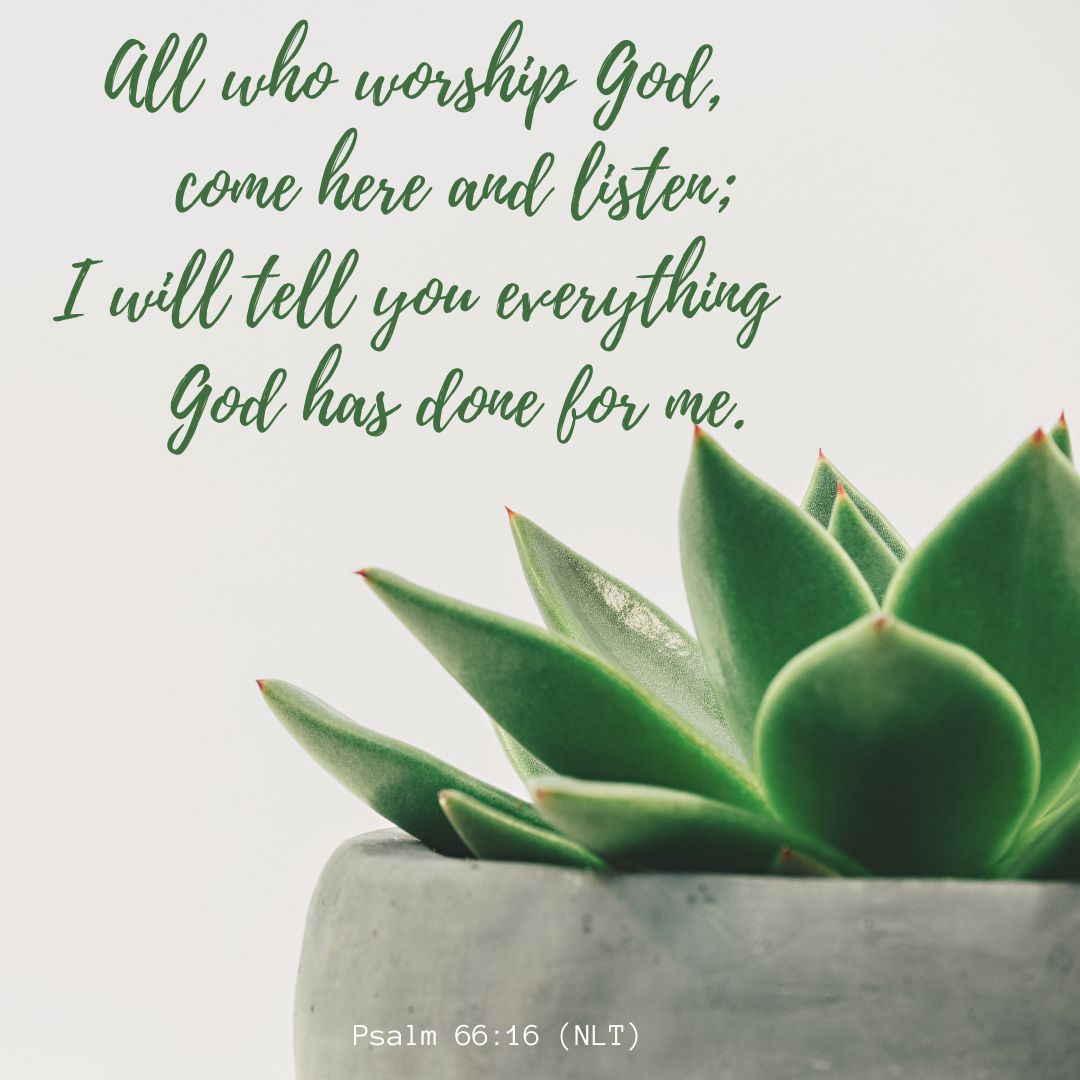
I think the psalmist sums it up pretty eloquently in Psalm 66:

As witnesses, we attest to what we have seen and experienced God doing. In this way, we join the great multitude of saints who have gone before us, proclaiming the love and grace of Jesus Christ.

Blessings and Peace,

Sara

Just Breathe: A Review of the Breathe Life Bible

Recently, I had the opportunity to review a couple of Bibles through the Thomas Nelson bible review program. One Bible that I chose to peruse is the Breathe Life Bible. Though I didn’t realize it at the time, this Bible is the perfect resource for anyone who is interested in exploring the crossroads where faith and justice meet. Though compiled with those in mind who daily feel the suffocating effects of racial injustice, it is most certainly not limited to one group. As former Ambassador to the United Nations Andrew Young writes in the forward, the Breathe Life Bible is about putting faith into action, taking an active stand against injustice and oppression. Young writes that this Bible “is about making real the Beloved Community where everyone is valued and cared for.”

When my youngest was about six, he and his brother were walking home from school one afternoon with a few other students who also lived nearby. One of the students had pulled out a Little Debbie snack to eat along the way, but before she could dig in, an older boy snatched it from her hand. My little firebrand would not stand for that. He promptly took the snack back and returned it to the girl, telling the older student, “That’s not right!”

This story always makes me chuckle–if you knew my youngest, you’d understand. He’s always had a fire in his belly to stand up to something, and as he’s gotten older, that hasn’t changed. My son feels strongly about justice…more aptly, he feels compelled to take a stand against what he perceives to be injustice. And there’s a lot of it. Walk down any street in your community and I’ll bet you’ll see it. Poverty; lack of access to resources like healthcare, mental healthcare, addiction treatment, quality education, fresh food; systemic violence….the list goes on and on.

Over the years, I have come to believe that our faith is intricately wound with justice. More specifically, I believe that God calls his people to acts of justice.

#saramsnyder.com

I love that the Breathe Life Bible says that the Lord requires his people to DO justly. This call to action encompasses Jesus’ command to love our neighbors as ourselves, and his exhortation to remember that whatever we do for the least of these, we do for him. But God’s message of justice often gets diluted in feel-good messages that only touch the surface of what it means to live a life of faith. As Christians, we have a tendency to become consumers of God, rather than people who act on his word. Author and leader Brian Heasley wrote in a reflection that, “Christianity is not a self-help group.” Though we sympathize with the plight of those suffering injustice, and maybe even empathize at times, how often do we act on their behalf? How often do we stand up and say, “That’s not right!”

The Breathe Life Bible is unique in that it also offers practical insight into how we can cultivate a life of social justice. There are essays by social justice leaders about what it means to put our faith in practice, commentary by Biblical theologians about what it means to act justly, special first-person accounts of Biblical characters that help the reader engage deeply and personally with God’s word, devotions written by pastors and teachers who share how God’s word impacts our lives, and opportunities to simply inhale and exhale God’s spirit.

Here’s a peek at some of those features:

God calls us to DO justice. And the Breathe Life Bible is a good companion for the journey. Regardless of which Bible you use, however, the fact remains that God doesn’t want us sitting on the sidelines of justice. Rather, he calls us to take action–to stand up and, in his name, work to make the world a better place.

God of Justice, open my eyes, stir my heart, and teach me how to do justly, and to love mercy, and to walk humbly with you today. Amen

Blessings and Peace,

Sara

Don’t Cling

Sometimes, my boys can be clingy. When they were younger, they used to follow me everywhere…and I mean EVERYWHERE. There were no shut doors in our house because they were entirely ineffective. If I went to the bathroom, little feet followed. If I had to take something to the basement, they trailed behind. Sometimes I played a game with myself to see just how long they would follow–walking circles around and around the house until one of them would finally say, “What are you doing?”

Now that they’re teenagers, the clinging is different. They still follow me around, but it’s mostly so they can talk at me about topics they’re interested in. Case in point: The other day, I needed to get somewhere by a certain time, but my fifteen-year-old didn’t get the message. As I went through the motions of trying to get out the door (brushing my hair, grabbing my keys, opening the garage door) he was there every step of the way talking, talking, talking. Every time I tried to interject with, “I really need to go,” he nodded as if he understood, but then just kept talking. Don’t get me wrong, I love it that my kids still want to be around me, even if it’s just to talk at me ad nauseam about random topics I’m not particularly interested in. But sometimes, I need them to let go so I can get things done.

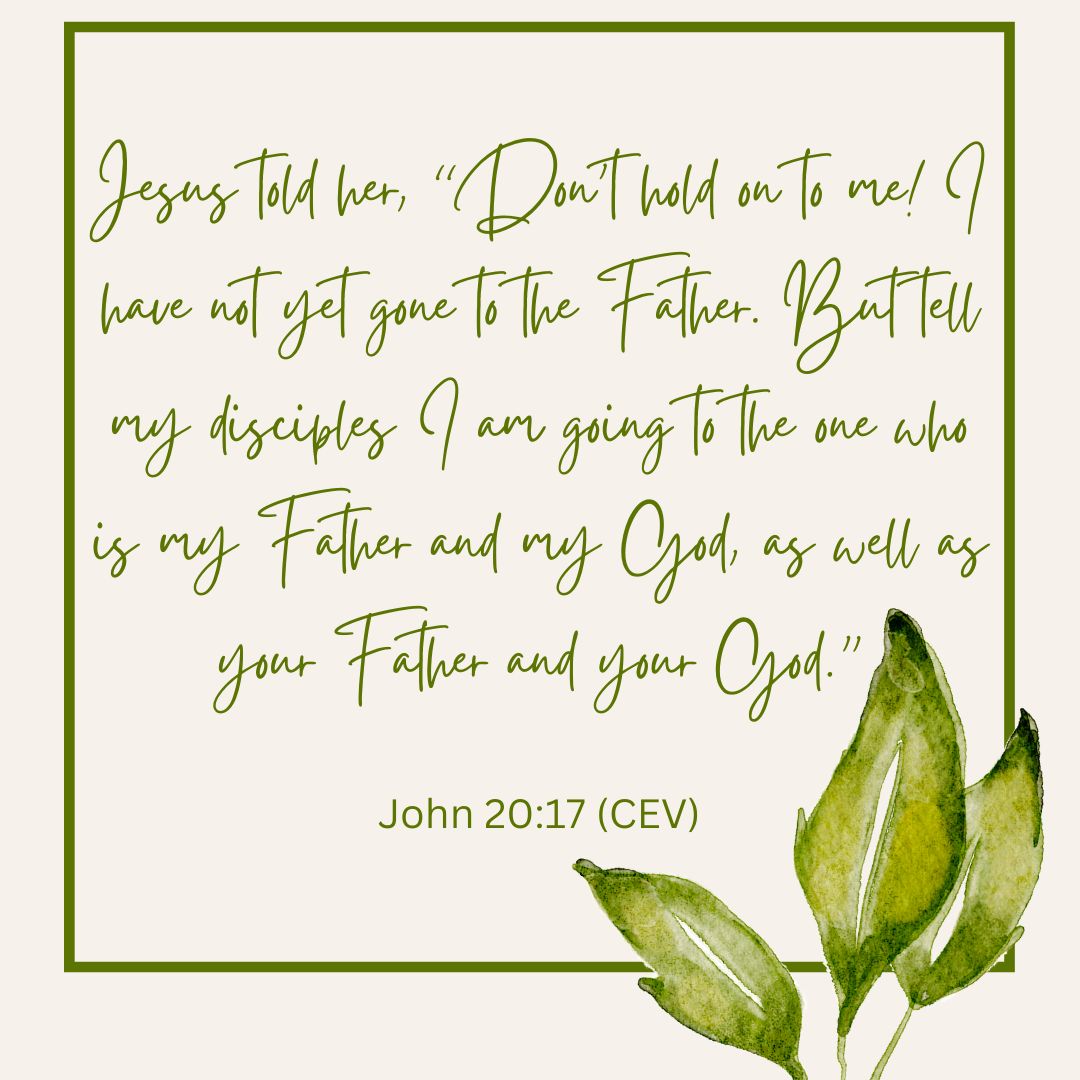
This past Sunday, we read the resurrection account from the Gospel of John–where Mary meets the risen Jesus in the garden, thinks he’s a gardener, but realizes her mistake when Jesus calls her name. And then, this strange conversation takes place:

#saramsnyder.com

Theologians will tell you that there is some supernatural alchemy taking place in Jesus at this moment that’s not quite finished. And while I get that, I think there’s another lesson Jesus is teaching, too. Simply put, Jesus is saying: Don’t be clingy.

Sometimes, we can linger a little too long at the spiritual mountaintop party and forget that Jesus gave us work to do–go spread the good news! Jesus tells Mary that she has an important jog. She must go let the disciples know that he’s alive. Later, after Jesus appears to the disciples, he gives them a job to do, too. He tells them to go out and make disciples of others.

If I’m being honest, it’s much easier for me to sit and read my Bible or listen to a feel-good sermon than it is to go out into the mission field. The world is messy. Being in new situations makes me uncomfortable. And sometimes, loving others seems impossible. I prefer the warm fuzzies of security blanket Jesus. You know, the constant reminder that God loves me. God chose me. God fights for me. You see where I’m going with this, right? When I cling too long to the idea of my Jesus, I make faith all about me. But as Jesus shows Mary, it’s really not.

Author Brian Heasley wrote that “Christianity is not a self-help group.” While we do grow through our faith and through our encounters with Jesus, we also have a calling. Time and again, throughout Scripture, God calls his people to act. Do justice, he says through the prophet Micah. Do good. Do what’s right. DO…

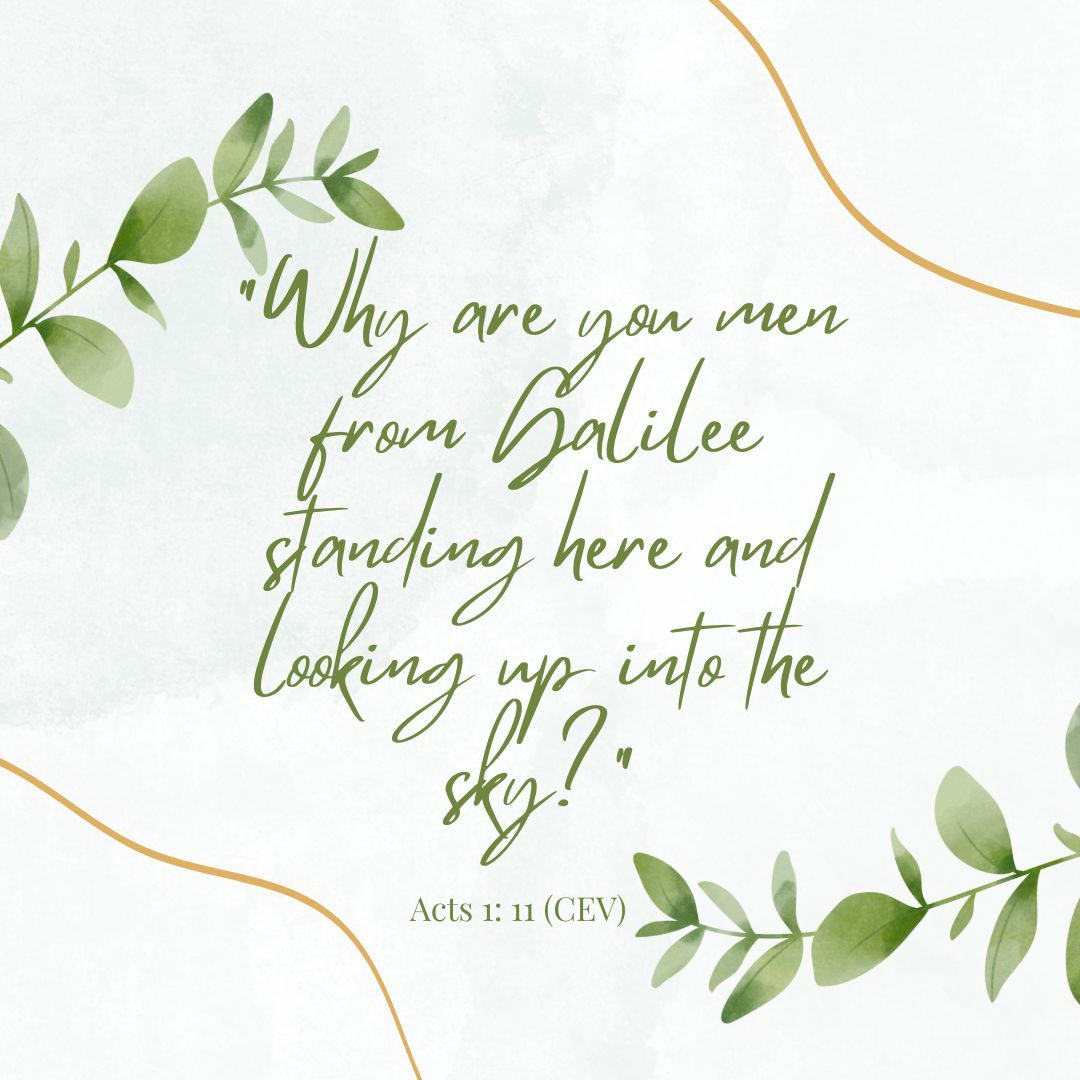
This is the same message the disciples receive after Jesus ascends to heaven. They are full of awe and wonder, looking skyward and examining clouds. Some of them might have even sat down, waiting and watching for Jesus to return. How long they would have stayed there is anyone’s guess. They might have built a house and just hung out for the rest of their lives, discussing philosophy and theology and trying to prognosticate Christ’s return–safe, comfortable, warm. But fortunately, God intervened. He sent two angels to ask a rhetorical question:

#saramsnyder.com

In that moment, the disciples remembered–they had work to do!

Like Mary and the disciples, we can’t stay at the empty tomb or keep looking to the skies. We can’t keep holding onto Jesus just to make ourselves feel good. Instead, we need to let go…just a bit…and do the things he has called us to. But in the letting go there is trust–trust that Jesus has equipped us, trust that he has gone before us, trust that he will not abandon us. And above all, there is the gift of the Holy Spirit.

In John, Jesus tells the disciples that he will not leave them as orphans; rather, he will send a helper and comforter to be with them always. So, when we take those first tentative steps away from the garden or down from the mountaintop, we can rest assured that we do not do so alone. God clings to us. That leaves our hands wide open to spread his love. Now that’s news worth sharing!

Blessings and Peace,

Sara

Confession 16: Maundy Thursday

I wrote this post several (okay, almost 20!) years ago, but as I was reflecting, the words God spoke to me then still ring true today. May you have a blessed Holy Week, remembering that you are loved and called to something beautiful.

This week has been so hectic for me, I have to confess that I completely forgot it was holy week until this morning. The sun hadn’t quite come up yet and I was already on my way to work. In lieu of morning radio (too perky dj’s rambling on about I don’t know what) I decided to listen to the silence for a while and spend some time in prayer. As I was praying through the day to come, I suddenly realized that it was Maundy Thursday.

In the past, this has not meant very much to me. I grew up in the Baptist church and we only celebrated Good Friday and Easter. Maundy Thursday was something the Presbyterians did down at the other end of the block. It never made much sense to me, mostly because I couldn’t see going to church Thursday night when you knew you would have to go back Friday and Sunday anyway. There was also the issue of the name, Maundy Thursday. What’s a Maundy? No one seems to know. I have actually heard the definition a couple of times now, and have read it once, but it’s nothing so significant that I actually ever remember it. So, what’s the point? I asked myself that question this morning, and here’s what I came up with.

Maundy Thursday is the calm before the storm. It is the last day of preparation before we walk down the road to the cross. It is the day where we commit ourselves to taking that journey with Jesus once more, even though we know it will be a painful process. More than that, it is an opportunity to come together as people of God to strengthen and sustain each other for the journey. Look at how John 13 begins:

xr:d:DAGAnZAyU44:13,j:7122865698710106757,t:24032613

Jesus knew hard things were coming, and he loved his disciples so much that he wanted to prepare them for the journey. More than that, he wanted some time alone with them to prepare himself, too, with those who had walked so far with him already.

The image came to mind as I was driving of someone who has been diagnosed with a major illness. Before physical treatments begin, there is a time of mental preparation. Most people meet with those closest to them to discuss the upcoming journey, and to commit themselves to seeing it all the way through, regardless of the end result. This, I believe, is what Jesus was trying to do for his disciples. He was preparing them spiritually, not only for the journey to the cross, but for a life lived in service to the resurrected Lord. In John 14, Jesus says:

xr:d:DAGAncGiEo4:4,j:5880998104413982920,t:24032613

This is a reminder to his disciples of who he is, and who he has called them to be. They are a people not abandoned, but empowered–fueled by the Holy Spirit to continue the work for which Jesus called them.

“Do this in remembrance of me,” Jesus said, as he passed around the bread and the wine. For me, on Maundy Thursday, the message is not to just eat and drink in remembrance of Jesus, but in everything I do to try and remember the love Jesus so willingly gave, and to pass that along to those I meet along the way.

Blessings and Peace,
Sara
Bonus Day

Happy Leap Day 2024, friends! On this special bonus day, I’m offering you some bonus content. Below is an article written by my husband, Chris, which inspired me to look at each day a little differently. I hope it speaks to you as much as it did me. Enjoy this extra day!!

Blessings and Peace,

Sara

I’m writing this on February 28 – typically the last day of the month.  BUT – not this year.  I know, it isn’t exactly news that every fourth year there is an extra day added to the month of February as a way to keep our seasons from getting even further out of whack (you know, like 80 degrees in February).  Tomorrow (likely today by the time you read this) is a bonus day, that special day added to the calendar once every four years to account for the fact that the Earth actually takes 364.25 days to orbit the sun. 

February 29 is one of those oddities of life.  Have you ever known someone born on February 29?  I’ve known at least 4 people with 2/29 birthdays.  I had the joy of celebrating with a church member several years ago his “21st” birthday.  It was fun to be with the 84-year-old man and his family as they playfully celebrated this milestone. 

I’ve always had this draw to February 29 as a “bonus day” or “gift day” because it does only come around once every 4 years.  It is something that doesn’t happen all that often and seems like it should be celebrated.  (Although, this year, I’m pretty sure the calendar doesn’t leave a lot of room to do anything too special.  We’ll see.)

But here’s the thing we forget sometimes: Yes, February 29 is special, but so are all the other days.  I shared a prayer above. This isn’t a new prayer, I didn’t develop it or just discover it.  I remember a professor of mine in seminary starting every class period with this prayer, and that is where it became meaningful to me. I say some form of this prayer most mornings prior to getting out of bed.  It reminds me that every day can be a special day. 

Every day is a “gift day” or “bonus day.”  Every day that my eyes open, that I get to spend with family and friends, that I get to participate in the building of God’s kingdom, every one of those days are bonus days. 

On this “Bonus Day,” I pray that God would stir up in you a desire to serve him, to live peacefully with your neighbors, and to devote EACH day to our Savior, Jesus Christ the Lord.

Blessings,

Chris

On Lent and Justice and Slogging Through Both

This past week marked the season of Lent–a time when many of us Christians give up or pick up habits in an effort to grow closer to becoming that person we believe (fingers crossed) God has called us to be. A few weeks ago, I read a devotion based on Isaiah 1:11-21 that lit a fire within me. If you haven’t read it, take a few moments to do so…I’ll wait.

In Isaiah 1, God has had it with the people of Israel. They’ve made worship a spectacle–kind of like the Super Bowl, but without T-Swift. They show up with their game-day gear, jump around, scream and cheer, get fired up and riled up, then go home feeling really good about themselves, secure in the knowledge that they’re part of team God and they will always bring home the bling. However…God’s not buying it. Look at what he says to the Israelites:

#saramsnyder.com

Yikes! I’m not going to lie, that kind of stings. That’s because I have a feeling, deep down, that Isaiah’s words are as true today as they were thousands of years ago. How often do we make our faith a performance–something we throw on Sunday mornings like a special-occasion dress so we can #church on social media? We tend make worship a bit of a spectacle, too, complete with loud songs, raised hands, and calls of “Amen” and “Praise Jesus!” None of this is wrong, per se, but God tells us that he wants more than the motions. In Isaiah, God’s not angry that the Israelites are worshipping emphatically–he’s furious that their so-called devotion doesn’t extend beyond the walls of the Temple.

While the Israelites are happy to bring sacrifices to God in worship, they most certainly aren’t doing so beyond that. They lie and cheat. They ignore those in need. They don’t defend the widows or help the orphans. And they oppress the immigrants. In fact, Isaiah goes so far as to say that the people of Israel have blood-stained hands. Maybe they haven’t physically hurt someone else, but their actions have perpetuated systems of injustice that have led to people being oppressed and neglected. When children are starving, who is responsible? God seems to say that we all are.

So, what does God want from us? Isaiah lays it out pretty clearly:

#saramsnyder

We are to be the people of hope–the feet that bring good news to the poor, sight to the blind, and release to the captives. Our acts of worship should fill us up with God’s spirit so that we can leave behind the walls of the church and bring God’s mercy and love to those on the streets…the hungry, addicted, enslaved, abused, grief-stricken, struggling, fearful, lonely people we meet every day.

God’s justice is different from the world’s justice. When the prophets speak of justice, they’re not always talking about retribution. Rather, it’s a reordering of priorities and practices. God’s justice is about freedom–breaking the chains of poverty, racism, sexism, ableism, violence, human trafficking, hunger, climate change so that all people can live into their God-given potential because all people are children of God.

God’s justice makes me want to move, to act, to sing the Good News into the world. Before Lent, I had a plan. I was going to make a justice calendar for myself that I could hang above my desk. There would be a daily act of justice, something small, but meaningful, I could check off each day. But as I considered this justice to-do list, I came to a daunting reality: You can’t schedule justice on a calendar.

The truth is, fighting oppression is a long slog through the bogs of humanity. Though we can give to the hungry, it takes a lot of time, effort, resources, and reordering of our systems of government and finance to ensure that every person can provide for themselves. Case in point, we once served a church that helped build a chicken farm in a community in Haiti. The farm was supposed to bring financial freedom to the people of the community and help their neighbors get sustenance, but these God-inspired goals were hit with the full force of political turmoil and economic oppression. The farm struggled, and though the people of the community are diligently trying to make it work, it’s an uphill battle.

Justice is hard, because it calls for a reordering of society. Justice is about relinquishing power, turning over our resources, making more room at the table for people who might make us uncomfortable. And honestly, I don’t always have the will or desire to do that. However, God is adamant that this is nonnegotiable. Remember when Jesus said: “Whatever you do for the least of these, you do for me?” That’s justice. And it’s so hard.

Fortunately, when it comes to hard things, we’re not alone. We have a God who can do infinitely more that we could ever plan or imagine. He makes things possible, though not necessarily easy. This Lenten season, I feel like I’m at the start of something. There’s a road that God is inviting me to follow, and I know we’re going to wind our way through some steep hills and marshy valleys. I don’t know anymore what this focus on justice will bring, but I know it’s a journey I have to take. Because we are kingdom builders. Even it we have to start with one small pebble at a time.

Blessings and Peace,

Sara
Are We Paying Attention?

Have you ever missed the turn onto your street? I’m not talking after recently moving to a new city or neighborhood–I mean a true head in the clouds moment where you blew right past the place you’ve been turning into for at least three years. I would like to tell you that this happened to me once….but the truth is….no one in my house is surprised when I miss an obvious turn. I just get distracted. There’s a great song playing and I’m singing along. Or a fox crossed the road and I’m craning my neck to see where it went. Maybe I’m too focused on the pinks and purples bleeding into the horizon as the sun sets. Whatever the case, I don’t always pay enough attention to where I’m going.

Recently, I was re-reading Moses’ call story. This is, hands down, one of my favorite stories in all of Scripture. I love that Moses is not a superhero. I love that he comes up with excuse after excuse to avoid God’s call. I love that Moses is plagued with self-doubt. I love that he boldly tells God he needs some muscle because he can’t carry this call alone. And, of equal importance, I love that Moses was distracted enough to have an encounter with God in the first place.

As Exodus 3 opens, Moses is tending sheep for his father-in-law. I don’t know a lot about sheep, but I cannot imagine it to be a highly stimulating job, especially for someone whose resume boasts “working royal”. With no smart phone, book, magazine, or radio, Moses had lots of time and space for his mind to wander. And that’s how he came to notice the burning, yet strangely not burning bush.

xr:d:DAF7RudQutY:3,j:8830849986575324288,t:24012914

In this passage, Moses was aware enough of his surroundings, yet distractible enough from his task at hand, that he noticed something out of the ordinary was taking place. Moses looked up. And when he looked up, he saw something new–something remarkable–and it sparked his interest. When Moses saw the burning, not burning bush, he was curious. And so, (like future shepherds would) he went to see this thing which had come to pass.

Here’s where the story gets really interesting: It wasn’t until Moses actually went to see what was going on that God showed up. Scripture tells us that an angel of the Lord was responsible for the fire. Though God had orchestrated the supernatural event, Moses had to take the first step before God called his name.

Sometimes, God needs to get our attention before he can get to work in our lives. And he waits until we’re invested before he speaks. Moses shows us that when God calls, sometimes it requires us to wake up and move!

Too often, I run around with my head so lost in the fog of my thoughts or an electronic device that I can’t hear God call. I’m not focused on where God and how he’s working and what he might be inviting me to take part in. And so, God gets my attention in some surprisingly odd ways. Like a cow…stuck in a fence.

Years ago, as I was going about my business, driving the two-lane highway past farms and fields that was my daily commute, singing along to whatever pop song was on the radio, I happened to spot movement from the corner of my eye. Turning my head, I saw something new–a cow that was entangled in a barbed wire fence. As my brain was attempting to process this strange sight, my cell phone rang. It was my sister, driving down city streets 200 miles away, passing storefronts instead of fences. When I told her about the bizarre bovine encounter, I expected a chuckle, or at best, a snort. But what I got instead was a question that entirely upended my way of thinking. She asked: “What are you going to do about it?” In that moment, my sister reminded me that we are not to be passive bystanders on the road of life. Rather, we are called to enter in, to act, to make a difference. Because if we don’t, then who will?

And so, I called the sheriff’s department and reported a wayward cow. I have no idea what happened next, if the cow was safely removed from the fence or became someone’s dinner, but I know that God used that cow (and my sister) to teach me a lesson that has factored into many of my ensuing moments. But before God could get to the lesson, I first had to notice…and then I had to move.

What do you need to look up from to see God working in the world? Where is he trying to get your attention? And are you willing to go and see what he’s doing?

Blessings and Peace,

Sara