Possibility

I love January. It’s cold and quiet is a welcome respite after the jangling hustle and bustle of the holidays. Sometimes it snows, transforming the grey and boring landscape into something sparkling and wonderful. On those days, everything comes to a full stop. We stay in pajamas and grab our blankets, cups of coffee or cocoa or tea, a good book or movie or board game, and take time to just be. And in the being, we have time to think…to consider…to dream. January, in its quiet possibility, reminds us that we don’t ever just remain what we are–we can grow–we can adopt new habits, set new goals, seek self-improvement. And for people of faith, it is a reminder of God’s graciousness, because the one who knit us together in our mother’s womb is still creating.

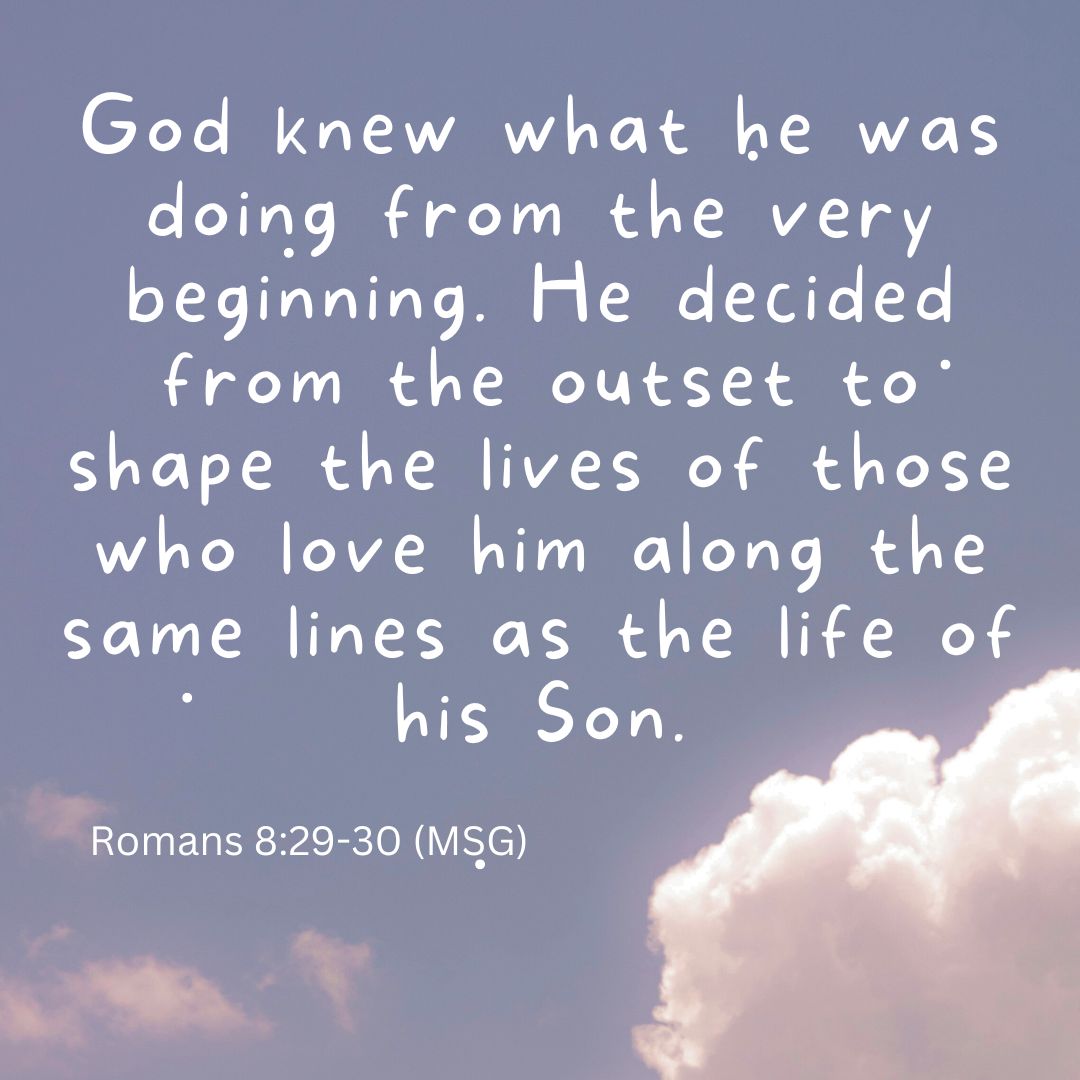
God doesn’t ever let us be. He is, as C.S. Lewis wrote, the “great hound of heaven” (or, if you rather Anne LaMott’s description–a stray tom cat yowling at the front door.) As Paul writes in Romans 8, God had a plan for us in the dawn of time. Millions of years before the first person would ever set foot on Earth, centuries before our ancestors began putting down roots, decades before our parents even considered the next generation, God was working in our lives to write his redemptive story.

God sees the possibility in our lives. He knows where we’re going, even if it doesn’t always seem clear to us. He knows the obstacles that will stand in our way, and is ready to hold us when the journey becomes too much. He’s there, every step of the way, teaching us and mentoring us–fashioning us in his image–not the one we see in the mirror–hand held out, inviting us to follow. God offers the gift of possibility. 

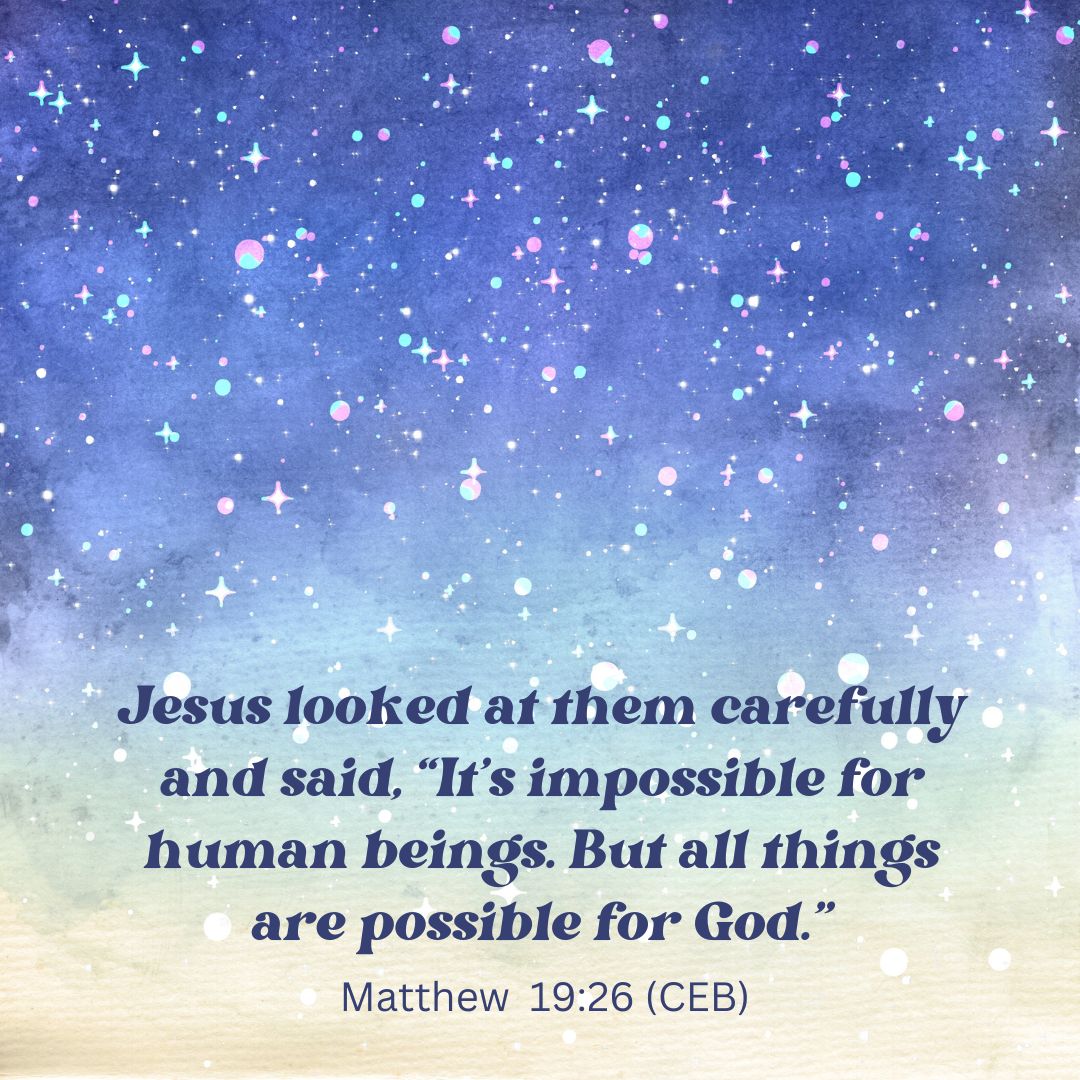
So, what possibility is God speaking into your life this year? What dreams is he whispering into your soul? If you’re like me, I bet some of them are pretty daunting. In my experience, God likes a big project–something I could never accomplish on my own. Like writing a book. Or pursuing a degree. Sponsoring a ministry. Even embarking on a new career path. Possibility can seem impossible, until God steps into the room. As Jesus told his disciples:

I don’t know how God will work out the possibilities he’s offering in your life. But I know it will be wondrous and surprising–surpassing all you could dream or imagine. My life at 46 is vastly different from the life I was working toward at 26…yet it is also infinitely better. When I accepted God’s call of possibility, it changed my life for the better, even if it wasn’t anything I had planned.

This January, as you contemplate change, take some time to lean into God’s possibility for your story. When we step into God’s possibility, we see the world (and ourselves) through his eyes, moving beyond who we are into who God calls us to be. Are you ready?

Blessings and Peace,

Sara

New Year, One Word: Compassion

Over Christmas, our family took a trip to NYC–along with half the world’s population! It was beyond crowded at most of the tourist spots. Just for some perspective, here’s a look at our ferry on the way back from Ellis Island:

See those life vests up above? Just decoration…if that sardine can went down, we were all going with it.

If I’m being honest, I am not really at my best among hordes of people. In my better moments, I see crowds as a nuisance–something to get through in order to experience something I want. And at my worst…well…I mostly wish they would just all go away so I can fully enjoy whatever I want to enjoy. It’s selfish and entitled, and I am fully aware of that in the moment. Unfortunately, that awareness doesn’t always precipitate change.

That’s why I am floored that Jesus’ response to the overflow of people hounding him along his journey isn’t one of exasperation; rather, Matthew tells us (three times!) that Jesus saw the crowds and had compassion.

Compassion is a powerful word. It’s more than just feeling bad for someone. Instead, to have compassion means that you are so deeply concerned about the circumstances of another human being that, according to Merriam Webster, you have “an urgent desire to aid” them. When Jesus saw the crowds around him, his heart was broken open. He saw their sickness, both spiritual and physical, and was compelled by an urgent desire to make them better.

Too often, when I look at others, I don’t see them with compassion. I see the poor choices, the dirty fingernails, the tattered clothes, the coarse language, the cloying neediness, the boisterous braggadocio, the condescending glance, the mental illness, or even the gleaming success….and I walk away full of my own self-righteousness, somehow thinking that Jesus’ compassion is a gift only for me.

In the gospel of Luke, Jesus gives those who will listen a lesson on compassion. Love your enemies, he says. Do good, and lend expecting nothing in return. If you do, you will have a great reward. You will be acting the way children of the Most High act, for–and this is the kicker– he is kind to ungrateful and wicked people.

God is kind to ungrateful and wicked people. And who might those ungrateful and wicked people be, per se? Get a mirror.

God always sees right into the hearts of his children. And when he finds their particular sickness (which we all have), he doesn’t turn away. He is so concerned for them, for us, that he has an urgent desire to act. God brings healing and hope to all those he encounters. And, if we’re willing, he’s offering us the chance to take part in this healing with him by showing others compassion.

We are called to be a people of compassion–a people who are so concerned with the problems facing other human beings that we have an urgent desire to aid them. But so often, we let our own sickness keep us from engaging in this practice. We put ourselves first, and quite honestly, most of us don’t even show compassion there.

This year, my focus word is compassion. I want to look at others with Jesus’ eyes–to see beyond the surface and into the heart, and to allow that knowledge of who, what, and why someone is (fill in the blank) break open my soul and lead me to act rather than pass by. It won’t be easy…I realize that I’m fighting against some deeply ingrained habits of behavior. But if I open the door of my heart to God’s compassion, I think that change will come…

Blessings and Peace,

Sara

To Be Known

The other day, as I was talking to my 15-year-old in the kitchen, I noticed that he was sporting a new watch–a Hello Kitty watch. Where’d you get that?, I asked. And then answered my own question before he could get there. His buddy, _____, of course.

This is the same friend who got my son a copy of Thomas Paine’s Common Sense for his birthday, and who encouraged him to learn the guitar. This is the same friend my son competes with on a daily basis to see who can get first chair in band, score the highest on a math test, bench the most at the gym, and get the fastest mile on their bikes. These two challenge each other, celebrate each other, and just generally get each other.

As a parent, watching your child form meaningful and lasting friendships with people who get them is one of life’s greatest blessings. There’s something wonderful about being known–about being understood. You don’t have to explain your reasoning, justify your thinking, or apologize for your emotions. You can proudly wear a Hello Kitty watch to high school because it’s funny and weird and that is who you are and your friend understands that.

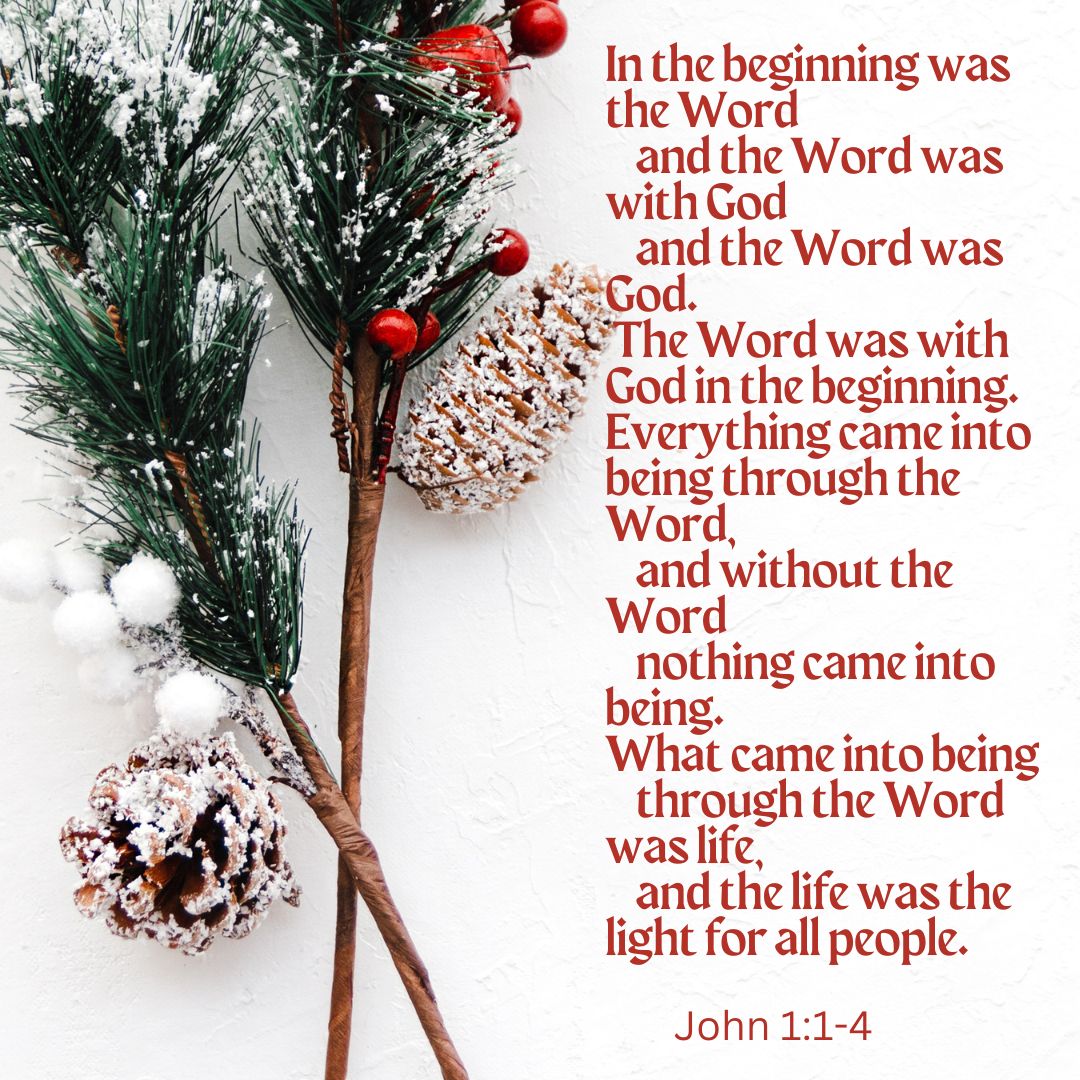
One of my favorite passages of Scripture comes from the Gospel of John. The “beloved”disciple begins his tale as all great tales start–in the beginning.

John establishes an almost symbiotic relationship between God and Jesus, both floating in the amniotic fluid of the universe and nursing new stars into being–each needing the other to bring forth their cosmic masterpiece. In the darkness of deep space light burst forth, and John tells us that the light was life spoken by the Word, and that this life-giving light of God was for all people. God, Jesus, and Spirit were one, and they enfolded humankind into their midst. Talk about a knowledge too great and wonderful for me!!

Often, when it comes to faith, I think we know (or think we know) a lot about God. We read Scripture and learn the stories of faith. We listen to teachers and understand the key points. We can say that God is good, or just, or merciful, or righteous. We can quote our favorite verses, and maybe list all of the books of the Bible. But knowing about someone isn’t the same as knowing them. To know someone goes so much deeper than being aware of the key events in their lives and maybe their favorite colors. We get to know others through relationship–in talking and sharing and laughing and crying and listening and understanding and journeying together. It takes time, and it takes effort, but the result is something so deep and beautiful and lasting that words can’t accurately convey it. It’s love distilled to its purest and simplest form. And it is what Jesus brings into the world.

John says that the Word became flesh and dwelt among us–we sing about it each December. But Jesus’ birth isn’t a pretty story to tell in the dark and cold of winter, it’s an opportunity to be known by the One who created us deep within our mother’s wombs. Because of Jesus, we can know God–we can walk and talk with him just like Adam and Eve did in Eden. And in Jesus, John tells us that the meaning and purpose of the universe–of life itself–comes into focus. Jesus invites us to know God as one of our closest companions, and it is in that knowing that our lives take shape.

At Christmas, we don’t celebrate the end of a story–rather, we celebrate the beginning of a deep and meaningful relationship. God made himself flesh and dwelt among us to bring us closer to him. How deep the Father’s love for us, indeed!

Merry Christmas!

Sara

The Advent Dilemma

“Slow down!” I called, pulling in with both arms on a leash stretched taut between our big baby of a Great Dane puppy and my hand–her barreling down the trail and me being dragged behind. “You go my pace! I don’t go yours!” I cried as she finally came to a standstill, looking back at me with an expression of annoyance that clearly communicated I needed to do a better job of keeping up.

The problem of ploughing pell-mell through the woods (beyond a dislocated shoulder) is that we miss the wonder and beauty and peace that comes from contemplating all of creation on display around us. There’s not time to pause and ponder the bright yellow leaf that has fallen, absolutely perfectly, into the middle of the path. There’s no time to stop and stare eye-to-eye at the brown-eyed doe tentatively assessing whether it’s safe to cross the path. There’s no time to marvel at the way the crisp, cool air expands your lungs, and the how the earth smells sharp and rich as it seeks to reclaim the leaves and twigs and smashed nut shells of the previous season. There’s just no time…

This is how I often feel during the season of Advent (yes, it’s still a thing; no, it’s not a countdown to Christmas), like I’m being pulled through something marvelous that I really want to stop and enjoy, but there’s just no time. Where Christmas is bright, big, and boisterous, Advent is retracted and reflective, requiring a certain amount of stillness and awareness. These are qualities our society does not endorse. And so we sprint through it to take in as much of the holiday hoopla as we can instead of waiting and watching and listening for the arrival of the holy, like those wise bridesmaids Jesus spoke of in the gospels.

In the above Scripture passage, the prophet Micah is lamenting the path the people of Israel have chosen. They have relegated God to an afterthought, and instead of listening for him, instead of watching and waiting for the deliverance God longs to bring, the people are living as they wish. The people of Israel rush around seeking to make themselves happy in a misguided attempt to close the gaping hole that no amount of money, power, luxury goods, or food seems to fill. There is conflict and animosity, injustice and idolatry in the wreckage of God’s perfect order.

And then there is Micah, who must feel like he’s screaming into the wind, compelling the people of Israel to remember before it’s too late that God only wants these things from them: to be just, to choose love, and to walk in humble obedience with God. But God’s path is a slow one, filled with detours and unexpected pit stops, and the people have no desire for such a seeming waste of time. So Micah sits, pulling his cloak around him, and waits–believing with every fiber of his being that he will see the Lord’s salvation when it comes. Micah stops to watch. He stills himself to listen. He doesn’t check his watch, add to his to-do list, or strategize a shopping plan. He just waits. And hopes. And listens. Do you know what Micah hears in the waiting? He hears the voice of God.

This is the beauty of Advent, if we truly allow ourselves to indulge in it. As we wait, as we watch, as we still ourselves to listen, we, too, can hear the voice of God. Sometimes it comes in wonder, as we gaze at God’s beauty in nature or in the companionship of those we love. Sometimes it comes in song, as we pause to listen to Christmas hymns both new and old. Sometimes it comes in Scripture, as we take time to dive into God’s word and find revelation anew. And sometimes it comes in the quiet of our stilled thoughts…a soft and gentle whisper nudging us in a specific direction or wrapping us up in acceptance and love.

Newbery Award Winning Author Madeline L’Engle puts it this way:

Advent calls us into a holy stillness. While the world whirls in a carousel of frenetic energy, blurring our thoughts and confounding our senses, we are called to hop off the ride and sit, like Micah, on the side of the road…waiting and watching…believing with every fiber of our beings, that we will see the salvation of the Lord. Come, Lord Jesus….

Blessings and Peace,

Sara

The Reason I Sing

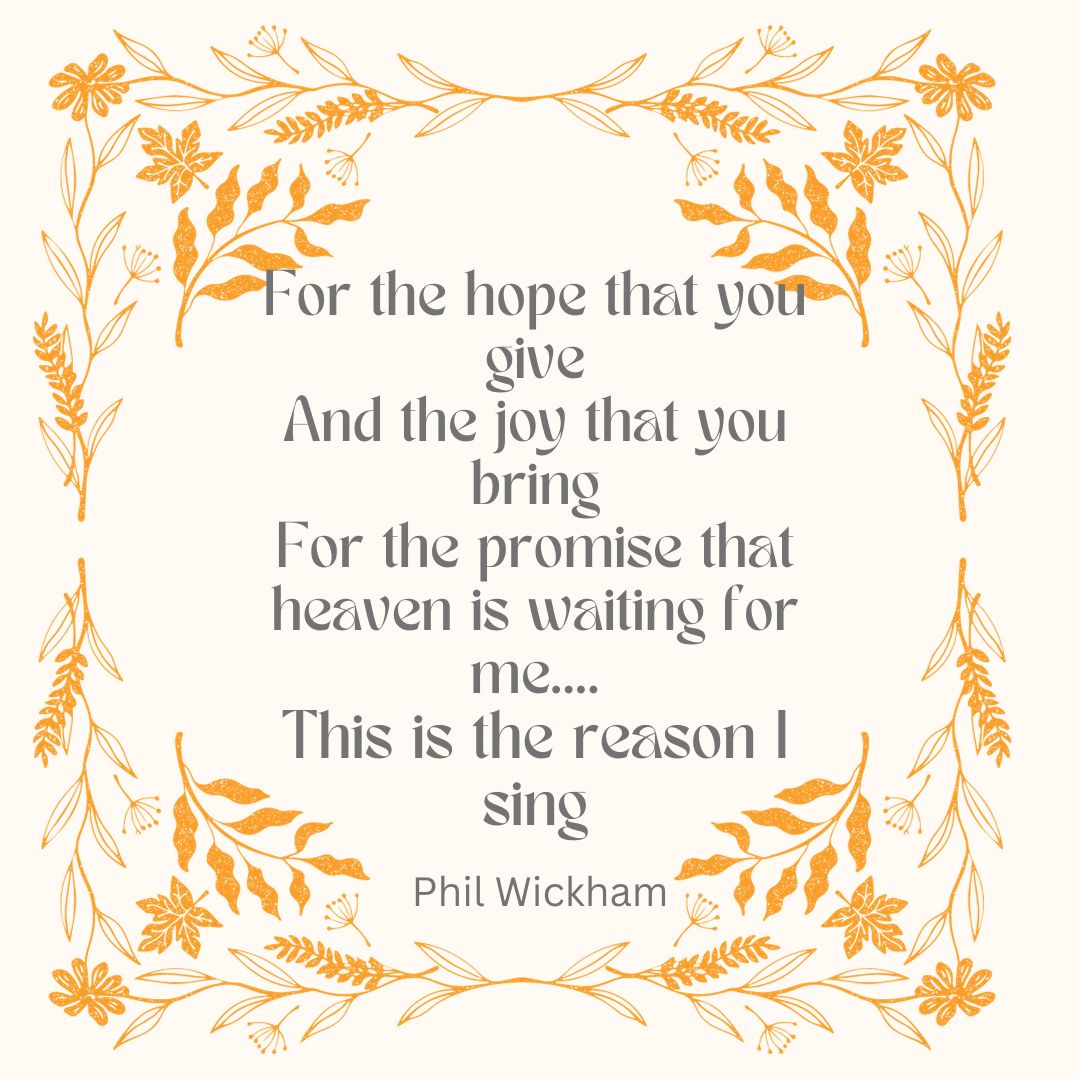
For several days this fall, I awoke with Phil Wickham’s beautiful hymn “Reason I Sing” playing through my head. If you haven’t heard it, take a listen here. I remember one morning in particular, when I was standing on the front porch watching the puppy run amok. The light was still new–you know–that happy pale yellow that makes everything look like an Instagram pic, and the sky was that perfect cerulean blue that only comes when summer is waning into fall. I remember looking at our bushes–which are big and unruly and always make me want to grab a shovel and start digging them out, and humming the chorus of Wickham’s song, when I had the unmistakeable awareness of the presence of the holy diffusing itself all around me.

Before you get all excited about some modern-day burning bush story that ends with me uprooting my family and heading to Egypt, let me clarify that I didn’t see my bushes on fire (though if they HAD been…never mind). No, in that moment of holy hello the overwhelming feeling that bubbled up inside of me was gratitude. I began thinking about all of the reasons I had to sing: breath in my lungs, a roof over my head, family peacefully slumbering inside, good friends to share the journey with, food on my table, work that I love….but mostly, that there is a God who created all things, who is full of love and mercy, and who calls me his own. And so, in that moment, the song I had awoken singing became a prayer of thanksgiving to the One who calls me beloved.

Gratitude is a powerful thing. I’m not talking about the merely polite “thank yous” we dole out when someone holds a door, hands us a receipt, or refills our water. I’m talking about that deep-from-your-soul spring of praise that bubbles up when you realize that you are walking with a holy presence, and the very fact that He IS means you are blessed. Maybe not materially, maybe not in health, maybe not financially, maybe not in peace…but for sure in the secure knowledge that you are held by the One who created the heavens and the earth and who holds eternity in his hands. And that is our hope. And that is our joy. And that, Wickham writes, is reason to sing.

That’s not to dismiss the horrors of the world–of which there are many. My heart breaks for the people of Israel, Gaza, Sudan, and Ukraine, especially the children whose lives are being ripped apart by unimaginable violence. I ache for those friends who are in the midst of the valley of the shadow of death–whether it be a physical loss of someone held dear, the end of a relationship, or a sudden change in life’s circumstance. But the fact that there is pain and suffering in the world shouldn’t diminish our capacity for gratitude, or cause us to cease lifting our voices in praise. On the contrary, I think, as God’s people, we are called to stand in front of that yawning pit of darkness and to fight it by lifting our voices together in a song of praise to the one who will make all things new.

Being grateful for what God has done in our lives doesn’t mean we’re ignoring the pain….it just means we’re choosing to put our hope in something more than that which can be found on Earth. And we know where that hope leads. It carries us to eternal joy, which is so much more than temporal happiness.

So this week, as we gather with loved ones to share a meal in a season meant for giving thanks, let’s lift our souls in songs of praise to the one who journeys with us, faithfully holding our hands as we navigate a road that can be broken, muddy, covered in boulders, hilly, and sometimes dark, knowing that he will lead us to where we need to be.

Blessings and Peace,

Sara

Timeless Truths Bible: A Review

As many of you know, I love Scripture. It’s how God and I connect on a day-to-day basis. As I read, I feel like I’m having a conversation with God, and it both fills and enriches me. Recently, I’ve also been turning to the words of those who have come before–some of those in the great cloud of witnesses Hebrews references. These are scholars, theologians, and church leaders who have helped to shape the Christian faith over the past few millenia. So, I was very excited when, as part of Bible Gateway’s Blogger Grid, I was offered the opportunity to review a free copy of the new Bible featuring the writings of some of these faith founders.

Called the Timeless Truths Bible, it is written in the New English Translation and features insight from leaders like John Wesley, Martin Luther, Augustine, and Charles Spurgeon. According to the publisher, the Timeless Truths Bible: “will encourage you through the always timely wisdom of those who came before us. Devotional notes and commentary from trusted theologians and pastors from the second century up to the twentieth will stir your affections. The ancient creeds and confessions of the faith will grow your understanding of what we believe—and have always believed. And artwork created throughout the history of Christianity will deepen your worship of the one we call Lord.”

Also included are:

  • Margin notes featuring devotional and theological commentary from notable figures throughout church history including Irenaeus, Justin Martyr, Augustine, Martin Luther, Ulrich Zwingli, Origen, John Wesley, Charles Spurgeon, John Bunyan, and John Calvin.
  • Forty-six full-page biographies of church leaders
  • The complete text of some of the creeds and confessions of the Christian faith that have shaped our beliefs for generations, including:
    • The Apostles’ Creed
    • The Nicene Creed
    • The Chalcedonian Definition
    • The Athanasian Creed
    • The Augsburg Confession
    • The Belgic Confession
    • The Westminster Catechism
    • The Lausanne Covenant
  • Book introductions for every book of the Bible
  • Full-color tip-in pages of artwork from the history of Christianity

As I’ve dug into these texts over the past week or so, I’m reminded that we do not walk this road of faith alone, and the insights and understandings shared from brothers and sisters over time both enrich and renew me. Reading their words, I feel more connected to a global faith, and feel an even greater responsibility to pass it to the next generation. This Bible is a through-line of faith, linking past and present. And though it is highly male-centric, leaving out the voices of faith-mothers like Susannah Wesley, Julian of Norwich, and Teresa of Avila, it is a remarkable resource that can help us unpack the timeless truths of Scripture and make them relevant to a new generation.

You can find the Timeless Truths Bible here or on Amazon.

The Scarcity Dilemma

Last week, in the middle of an aisle at Sam’s Club, I felt the warning signs of an impending anxiety attack. As I stared at my cart piled to the brim with boxes and tubs and pre-packaged everything, my heart began to pound and my temperature rose, then cooled, while the pit that often lays dormant my core began to open and gnash its pointy teeth.

“Is this enough?” I wondered. “Will everyone have enough to eat? Maybe we need a greater variety of chips? Do we need more drinks? And what about dessert? We can’t run out of dessert. But we’re already spending a lot of money. I shouldn’t spend anymore, right?” With everything pounding inside and a sinking feeling spirit, I headed to the checkout where I handed over both my debit card and my goods–feeling terrible about both.

This, my friends, is what it’s like to live in a culture of scarcity. Nothing is ever enough, and all that we have in abundance is anxiety. I know you can relate. It’s how we roll in the western world. Marketers tell us that we need to buy something fast because those shoes won’t be on sale next week and the Pumpkin Spice Latte only lasts for a season. We’re taught to consume it all before it’s gone–YOLO, am I right–while at the same time being told to hoard everything in case you need it down the road. It’s no wonder a trip to the grocery store often feels like stepping into the Hunger Games arena!

But it’s not just about finite resources. We have the same scarcity principle of time–cramming our calendars to overflowing so as not to miss out on something, while bemoaning our lack of time to do the things we truly enjoy. In our minds, everything can become nothing in the blink of an eye…so we perpetually focus on the not enough.

Like most things in our world, the scarcity deficit from which we operate is the complete opposite of what God envisioned for his kingdom. Consider this passage from Psalm 36.

I love the imagery here–how God calls us not to amble over for a light pre-game snack, but to run and eat our fill of heaven’s bounty while quenching our thirst from Eden’s own spring! There is no scarcity in God’s realm…there is only fulfillment. Need more proof?

Consider the creation story, when God caused light to burst into the void that was the Earth, then brought forth lush vegetation, waters teeming with life, and a myriad of creatures roaming the land. Or Abram, whom God called to marvel at the fullness of the night sky, then said that Abram’s offspring would outnumber even the vastness of these celestial jewels. Later, as Abram’s offspring wandered the wilderness and wondered what was for dinner, God made sure their bellies were full of heavenly bread and succulent meat. Then there is Ruth, who gleaned in a field in expectation of finding meager sustenance, only to have Boaz instruct his workers to leave piles of wheat for her to gather. And can we forget the woman at the well, whom Jesus promised streams of living water so that she would never thirst again?

Our God is abundant. There is no scarcity to be found in his work, in his love, in his mercy, in his grace. So why do we choose to live as if there is a deficit? Why do we insist that we don’t have enough when we worship a God whose very nature is one of generous giving. God gives–fully, completely, abundantly. There is enough…for…all…people.

There are those in this world for whom scarcity is a real and life-threatening situation. But it doesn’t have to be this way. God teaches us that there is enough–he made enough–so that all might have an abundant life. And guess what? He’s calling you and me to be his agents of generosity! We don’t need to grab all we can while we can because God has promised that he will give us what we need when we need it. I love the way John puts it:

Instead of thinking about all we lack when God comes knocking on the door to our hearts, what if we choose to focus on all that God can offer? What if we say:

Yes! I will give one hour a week to a kid who needs a caring adult to talk to, knowing that God will make the time multiply.

Yes! I will commit to tithing ten percent of my income, knowing that God will ensure I have enough left over to support my family.

Yes! I will contribute to a holiday drive knowing that my resources will add abundantly to those of others in order to bless someone else.

Yes! I will sign up to help with that new ministry at church God has been bugging me about, knowing that he will open doors and make a way where I see only obstacles.

Yes! I will take the time to check in on a friend or neighbor, knowing that the joy of fellowship will fill me far more than whatever else I would have consumed in those minutes.

God gives us gift after gift. So, this week, try to consciously avoid the mindset of scarcity. Instead, give your fears, what-ifs, and doubt to a God who has more than enough to meet your every need.

Blessings and Peace

Sara

On Change…

A few months ago, we brought a new family member into our lives. This is Roxie–a now 4-month-old Great Dane pup. And while she looks pretty docile in this photo…looks can be decieving.

Puppies, like children, disrupt everything. When Roxie entered, routines were smashed in a frenzy of jumping, biting, snuggling, and potty breaks. I quickly discovered that her morning zoomies happened to coincide with my daily quiet time. Before Roxie, I meditated on God’s word sitting on a step stool in the kitchen–opening my soul and senses to the presence of the Holy as coffee brewed and the house slowly awakened. After she arrived, I stubbornly attempted to cling white-knuckled to my old routine. This is what I do each morning. This is how I worship God, and nothing is going to change that, no matter how many times a puppy comes crashing through the kitchen.

You can guess how that worked out. A typical beginning to my prayer time would go something like this: God, as I still my thoughts before you…”Roxie! Drop it!!”…As I enter prayer now…”Get off of that chair!”…God, would you open my heart to…”Ow! No bite!! Let go–I said let GO!”

Frustrated at my lack of progress, I decided to do what many people do when change is thrust upon them–I quit. If I couldn’t meet God on my terms, then I decided I just wouldn’t meet him at all.

While completely irrational and contrary to everything I know to be true, my stubborn spirit was unrelenting. It’s like the question the psalmist asks in Psalm 11:3. I justified it to myself by saying, It’s just a season. I’ll pick up where I left off when she’s older. God, however, felt otherwise.

Over the past few weeks, God has been whispering into my soul. His words are simple and logical. He says, “You can find new places and spaces in your life to be with me.”

Yet as a creature of habit, I resist these kinds of messages. While I think change is fine for other people, I really am not interested in practicing it myself. My stool is a venerated object–the kitchen my sacred space–the end. But here’s the thing God is teaching me: Anyplace is sacred once God enters in. Think about where you worship God. Is it really limited to one concrete place? When I’m being honest, I can recognize that I have worshiped God by campfires, in cars, on airplanes, in the shower, at huge events, and in the darkness of my bedroom at night. Experiencing God is not a function of place, but of purpose. And it’s not predicated on what worked in the past, but on where we find ourselves in the present.

While most of us resist it, life is change. Seasons come and go. We grow and evolve. Hopefully we mature. We experience new things that broaden our minds and enhance our understanding. But too often, as people of faith, we tie ourselves to the past and refuse to move forward. There’s comfort and familiarity in the way we’ve always done something–but it’s not realistic or sustainable. We don’t worship a God who lives in the past, but one who is moving and acting and saving in the present. He’s ready and eager to meet us wherever we are. As Psalm 11 continues…

The Lord is always in his holy temple, so we don’t need to get caught up in ideas of place or space. God will meet us wherever we are, in whatever season we’re in, to fill us up so that we can go forth and serve in his name. This week, give thanks for all of the things you loved in the past, including those special places where you encountered God. Then, take a deep breath, and walk with anticipation with God (and maybe a puppy) into the future.

Blessings and Peace

Sara

A Future of Impossible Hope

As I write this today, any number of awful things are happening in the world. Communities have been devastated by fire, flood, and wind. Wars rage, violence erupts on city streets, governments that are supposed to protect oppress instead. Tragedy strikes, grief lingers, jobs are lost, and doctors can offer little to ease the mind. Sometimes, it doesn’t seem like God likes us very much, let alone loves us.

In my experience, one of the biggest stumbling blocks to faith for people who are non-believers lies in the absolute tyranny of life itself. How can a God who is love sit idly by while tragedy strikes, trauma endures, sickness continues, and injustice abounds? Truth be told, the most reasoned and best articulated answer I can give people who question God’s motives is simply this: The world is broken, and sometimes, it sucks.

But I can also unequivocally tell you this–God does love us, and the proof of that is everywhere. It’s in early-morning hours as the peachy orange of a new dawn slowly pushes the night away and the birds emerge from their slumber to sing the day into being. It’s in the praise song that fills my heart and compels me to sing as I take my son to early morning band practice. It’s in the daily reminders that my life is full of people who love me: texts from my mom sharing news of the day, calls from my sister while she’s waiting in the drive-thru lane at Starbucks, Sunday evening conversations with my in-laws as we unpack our week. God’s love is in the rhythm of daily living that my husband and I have cultivated together over the past 19 years, full of conversations about everything and nothing, laughter and love. It’s in those moments where I look at my boys and see glimpses of the thoughtful and talented men they are becoming, realizing that God is working in their lives even when I don’t notice.

When your heart is full of compassion and kindness, that is God’s love shining through. Paul reminds us in the letter to the Ephesians that God’s love doesn’t just skim the surface of life. It’s not temporal or transactional. It doesn’t ebb and flow. Instead, it is deep and wide, reaching well above and beyond anything we can grasp, let alone comprehend.

I think if people truly understood the height, width, depth, and breadth of God’s love, if they knew they are well and truly loved completely, then I have to think the world would change. This, then, is our mission as those who already know God’s all-surpassing and ever-encompassing love: We must be bearers of love until every person on this planet knows there is something bigger, something more powerful, something more sacred than what our eyes can see. If we truly want others to know God, then we need to love them.

And so, today, I offer this prayer:

God, give us courage and strength to love as you have loved.

God, give us patience and wisdom to love those whom you love.

God, give us compassion and understanding when we are seeking to share your love.

God, give us power to show love in ways that help others see there is a greater love.

And God, let us love because you love us.

In Jesus’ Name…Amen

The Greatest Mystery of All

Knowledge…it is something I value above most things. As a writer, my favorite days are research days…when I spend hours combing through Google articles, my eyes scanning texts for nuggets of information as my fingers tap out questions like: Why did megalodons go extinct? How does the filibuster actually work? Who invented the water slide? What exactly does G-force mean? And though sometimes it takes a bit of digging and much cross-referencing of sources, I can usually come up with the answer (the climate changed, hard to say–but one of the first recorded water rides was built in New Zealand in 1906, the force of gravity or acceleration on the body).

Whenever someone in our house is feeling unwell, I turn to Google for a diagnosis before calling the doctor’s office. When our beloved Newfie passed away last month, I researched pet cremation because I wanted to know what would happen to him next. And when my brand new sewing machine quit working correctly, I turned to YouTube to figure out how to fix it myself–and learned about the function of tension in the process!

People say that knowledge is power, but its power comes from the fact that it leads to understanding. And understanding leads to informed decisions.

That’s why it often confounds me that so much of faith is still a mystery. Despite all of my knowledge of God, I still have so many unanswered questions. Why does God let people suffer? How does eternity work? Is heaven really a place in the hereafter, or do we have it all wrong? Will God truly send people away from him after working so hard to save humanity? If God forgives and forgets, why do so many churches still talk about judgement? And how can God really be everywhere at once?

Yet as I was meditating on Psalm 8 last week, a thought occurred to me. Though there are many mysteries in this life of faith, perhaps the biggest mystery of all is that God loves us.

We are a people who spend most of our waking moments focused on our selves–on our self-preservation and self-perpetuation. If I’m being honest, I would have to say that a large chunk of my thoughts are self-directed, from pondering what I want to eat to thinking through conversations in my head, it’s all about me, myself, and I. Sound familiar?

And yet, God loves us anyway. Why? We’ve never once given him a reason to do so. In fact, a quick scroll through history will show that we’ve given God ample reasons to wash his hands of us. But instead, he keeps calling. From the beginning to the end, our Father who loves seeks us out and gathers us home. And this all-consuming love of God is, I think, the greatest and most holy mystery of faith–a strange and perplexing force out there hovering in the cosmos like the Oort Cloud (Google it). I can’t tell you why God continues to love us–it’s enough to know that he does.

God set us apart…making us just less than divine, Psalms says, but crowning us with God’s own glory and grandeur. It’s overwhelming to think about–kind of like looking up into the vastness of the night sky. When I consider the stars, I am diminished. I remember that in the grand scheme of the universe, I am but a blink, a breath, a bubble. When I’m gone, I will leave nothing lasting–nothing immemorial. My name will not become a question future Jeopardy contestants will answer. But yet, God says, “You matter to me.” And he says the same to you.

How do we respond to such a mystery? How do we let the knowledge of God’s unfathomable love shape us? My hope is that it moves us out of ourselves just a little bit farther and closer to the one God has called each of us to become in him.

This week, I would encourage you to spend some time outside looking to the sky. Lose yourself in the great cosmos of stars and planets that circle above. Be small, and in that smallness remember how very much you are loved. And let that love be enough.

Blessings and Peace,

Sara