Confession 373:Use Your Gifts

The Spirit has given each of us a special way of serving others.  1 Corinthians 12:7 (CEV)

images-2

When I was a classroom teacher, I always tried to discover the different gifts and abilities of my students.  Knowing where their unique strengths and abilities helped me better understand how they learned.

As a parent, I believe that one of my roles is to identify and help develop the different gifts and abilities of my boys.

My boys tend to be fairly atypical.  They prefer playing with stuffed animals over action figures, legos over jungle gyms and doing Rainbow Loom rather than going outside for a pick-up baseball game.  This used to bother me.  Buying into cultural stereotypes about gender expectations, I wondered if I was doing something wrong.  Then I had a realization.

My boys are creative.  And that’s okay.  As a parent, my job is to nurture that desire for creativity.  When my youngest wants to get creative in the kitchen, I grit my teeth through the spilled salt and splattered eggs to help him create a one of a kind dish.

When my oldest wants to create yet another Disney Rainbow Loom charm on the computer, I give him time, my computer, and the entire dining room table to do so.

Nurturing gifts is important because God has imparted them to each of us for a reason.  Our gifts are not meant for us alone.  They are meant to benefit others.

The Spirit gives us gifts in order to serve others.

images-3

Yet often in our busy and frenetic world, our spiritual gifts get neglected.  They lie dormant as we shuttle ourselves and our families through the daily grind.  We wait to use our gifts for a more convenient time, or after they’re better developed, or when we have more money to invest in them.

Sitting on our spiritual gifts is like leaving a Christmas present unopened.  There’s really no purpose in having it.  And, it sends a negative message to the one who gave it.

Instead, we need to open up our gifts.  We need to play with them, grow them, build on them and use them.

You might be thinking, “I don’t have any gifts.”  However, gifts come in all shapes and sizes.  What do you like to do?  What brings you joy?  Chances are, the answers to those questions point to a gift.

“Yeah,” you might be thinking.  “But what I like to do is… (read, listen to music, bowl, play baseball, garden).  How can that be a gift to others?”

Begin by assessing the needs of your community.

In our town of about 1200, there was a group of people who liked to read.  However, the nearest library was ten miles away.  This group worked to establish a community library, staffed by volunteers who wanted to share their love of reading with others.  Today, the library provides a variety of resources and services to the community, including summer reading programs for kids.  The gift of reading shared by a small group of people has impacted an entire town.

Using your gifts doesn’t have to be huge.  Small acts are equally important.  Small acts can change a life.

Several years ago I took a group of sixth graders to work on a Habitat for Humanity build.  The kids laid sod, painted, planted flowers and pushed wheelbarrows full of gravel.  They had a great time running around outside.  While their work seemed small, it was the finishing touch on a home that would provide much needed shelter to a family who had never had a home.

Big or small, using our gifts is important.  This week, I would encourage you to reflect on the gifts God has given you.  Then, ask God to open up some areas in your life to use those gifts for others.

Blessings and Peace,

Sara

Confession 372: What’s Your Why?

Christ didn’t send me to baptize, but to preach the good news.  1 Corinthians 1:17

Have you ever gone shopping without a purpose?  Wandering aimlessly through department stores can be a stressful experience for me.  I either buy things I don’t need and then feel guilty about it.  Or, I become overwhelmed by the sheer magnitude of all the “stuff” stores have and feel anxious and depressed.  While I love shopping, I generally need a purpose for it–even if that purpose is that Old Navy is having a really great shorts sale!

Purpose is important.  Purpose gets us out of bed in the mornings.  Purpose propels us forward.  Yet often, many of us go through life with no clear idea about our purpose.  We feel anxious, depressed and overwhelmed because we don’t know why we’re doing what we’re doing.  The daily grind becomes a true grind.  There’s no joy in our work.  There’s no joy in our kids.  There’s just a to-do list.

As John O’Leary writes in his book On Fire: the 7 Choices to Ignite a Radically Inspired Life, “We spend the vast majority of our efforts and life focused on the how.  The how consists of the tasks, the duties, the obligations, the stuff, of life.”

On Fire

I’m providing a link to O’Leary’s book here.  I’m providing a link because I believe you should absolutely, positively, unequivocally, right now read this book.  Go.  Buy it.  Read it.


The how is not what inspires us and drives us.  The how leaves us depleted.  It’s our why that continues to push us forward.  It’s our why that gives us a reason to get out of bed on days we’d rather hide under the covers.  As O’Leary writes, “When you know your why, you can endure any how.”

Most of the leaders in the Bible knew their why.  Moses knew his task was to lead the people of Israel out of Egypt.  If he had focused solely on the how, they never would have made it.  Moses probably felt like throwing in the towel several times.  But he had his why.  God had called him to a task.  Knowing his why allowed Moses to keep going, even when it seemed hopeless.

Paul knew his task was to preach to the Gentiles.  It wasn’t easy.  His life was threatened in almost every community.  He was challenged, arrested, beaten and contradicted.  However, Paul knew his why.  He wrote it over and over in his letters to the Gentile churches.  Jesus called him to preach to the Gentiles.  Knowing his why allowed Paul to endure the physical abuse, emotional turmoil and mental exhaustion of his ministry.  Knowing his why enabled Paul to follow the path that led to his execution and gave him the strength to proclaim the love of Christ the entire way.

Why is important.  When I first began to think about my “why” statement, I thought of my family.  Why do I do what I do?  Because my family needs me.  However, upon reflection, I realized that my family might not always be there.  My kids are young now, but they won’t always be.  I needed something deeper–something I could carry with me through all the phases of my life.  I also needed simplicity.  If it’s too complicated, I’m not doing it!

After a time of prayer, I came to this conclusion.  Why do I get out of bed in the morning?  Because God has work for me to do.  While simple and not profound, this statement works form me.  This statement inspires me.  This statement propels me forward.  This statement validates my “how”.

Why do I need to do the laundry?  Because it’s the work God has given me to do today.

Why do I need to post something on my writer Facebook page?  Because it’s the work God has given me to do today.

Why do I need to grind out a blog post?  Because it’s the work God has given me to do today.

Why do I need to help with a church event?  Because it’s the work God has given me to do today.

Do you see the power of the why?

Today, I want you to work on filling in the blanks in the passages below.  Take time to carefully consider your responses.  Pray over them.  Ask God to illuminate your answer.  Find your why.

Why do I ____________?   Because _______________________________.

Blessings and Peace,

Sara

Confession 371: Do You Want to Die?

So the Lord isn’t the God of the dead, but of the living. This means that everyone is alive as far as God is concerned.  Luke 20:39 (CEV)

On Fire

Do you want to die?  This is the title of the first chapter in John O’Leary’s inspirational book, On Fire: The 7 Choices to Ignite a Radically Inspired Life.  It is also the question O’Leary’s mother asked him when he was nine years old, laying in an ER bed with third degree burns on almost 100 percent of his body.  Do you want to die?

Like most of us, O’Leary’s response was no. His mother went on to tell him that if he didn’t want to die, he needed to fight harder than he’d ever fought before to live.  O’Leary writes that, “Life is not about avoiding death, it’s about choosing to really live.”  He states that:

We all have that choice.  We choose to vibrantly go about life, soak it up, embrace it, and celebrate it, or we choose not to.  No one else can make this decision for us.  We get one life.  We either choose to live.  Or we choose to die. (O’Leary, 2016, pg.10)

Like many people, my life can get stuck on autopilot.  I get caught up in the daily drudgery of routine, failing to embrace and celebrate the fact that I get to make lunches for my kids to take to school.  I forget to vibrantly wash dishes and do laundry, appreciating the time and space these somewhat mundane tasks give me to reflect, to pray or even to be still.  I forget sometimes to really choose to live.

When Jesus talks to the Sadducees about life and death in Luke 20, his focus is on the resurrection (which the Sadducees didn’t believe in–it was a trick question).  Jesus is establishing, through Moses’ encounter with God at the burning bush, that all of God’s children share in eternal life.  Therefore, God is not God of the dead, but of the living.

The question for us Jesus followers is whether or not our lives reflect this truth.  Do we live as people who have been given victory over death?  Or, do we live in fear of death?

I’ll be honest with you.  I often find myself living in fear of death.  I’m a total hypochondriac.  A mosquito bite in my armpit often becomes a death sentence in my mind.  If one of my boys has a stomach cramp, I immediately think there’s some sort of internal blockage.  Fortunately, I married a realist.  He calmly talks me down from the “we’re all going to die!” ledge and says helpful things like: “It’s a mosquito bite.” Or, “He ate three hot dogs.”

My fear of death prevents me from truly embracing, celebrating and vibrantly living life.  By fearing death, I’m giving death a power over my life that Jesus already vanquished.  In working to avoid death (which is impossible) I’m not taking ownership of my life.

freedom (Sara's blog)

This is one of the key choices O’Leary lays out to ignite a radically inspired life.  We have to  take ownership of our lives.  We have to be accountable for our choices, both good and bad.   When we take ownership of our lives, we can choose the path forward.  We can choose to forgive.  We can choose to let go.  We can choose to encourage.  We can choose to build up.  We can choose to serve others.  We can choose to be present.  We can choose to enjoy the mundane tasks.  We can choose to engage others.

In short, when we take ownership of our lives, then we choose to really live.

God is the God of the living, not the dead.  Let’s choose this week to really live.

Blessings and Peace

Sara

Confession 370: Why I Don’t Read Parenting Books

Let’s hold onto the confession of our hope without wavering, because the one who made the promises is reliable.  Hebrews 10:23 (CEB)

parenting-books

I never read parenting books.  Okay, that’s not true.  I’ve read exactly one and a half parenting books since becoming a parent almost ten years ago.  It’s not that I think they’re bad. They can be very helpful.  It’s just that parenting books have a tendency to eat away at the core of my self-confidence as a parent.  In other words, they stress me out!

The truth is that when I read a parenting book, I feel like I’m doing everything wrong.  There’s so much pressure in our culture to raise intelligent, successful, emotionally mature, athletically superior, gifted, well-mannered, deep thinking kids that my almost 8 year old’s proclivity to burp on command seems a marked failure on my part.  I just can’t take it.

My general rule of thumb in parenting is to get advice from a few select friends and acquaintances who have a deep understanding of parenting (and read parenting books).  It’s so much easier for me to hear, “Maybe you can give him a list of acceptable places to burp,” from my good friend Susan, a licensed counselor, than to read the same advice in a book written by a licensed counselor I’ve never met.

The difference is that I trust my friend.  I trust her because I know her.  I trust her because she knows me.  I trust her because we’ve shared stuff; big life stuff.  I trust her because over the course of the past six years we’ve worked to develop a close friendship.  We know each other’s stories.  We share similar values and beliefs.  She understands me.  And I understand her.

Sometimes, I think we struggle to trust God because we don’t feel like he really understands us.  Trusting God can feel like getting parenting advice from someone you don’t know.  We wonder, “Does he really get what I’m going through?  Does he actually have my best interest at heart?”  Or even worse, “Is God judging me?”

The answer is no, by the way.  God isn’t judging you.  And yes, God understands what you’re going through.  Yes, he does have your best interest at heart.  The thing is, we can’t see that because, while God understands us, we don’t always understand God. God is not a trusted friend, he’s more of an ephemeral concept.  We know God’s there, but we rely on him the same way we might rely on Dr. Oz.  We watch his show a couple of times a week to pick up tips on living better.

As Jesus people, our relationship with God has to be just that–a relationship.  And, relationships take time to cultivate.  They also require a great deal of active engagement.  It’s not enough to read the Bible, we need to engage it.  We need to see our study of Scripture as a conversation with God.

Talk to God while you read.  Tell him when passages don’t make sense, or when you respectfully disagree.  Thank him for the passages that encourage you and inspire you.  Be open to advice and instruction God may be giving you as you read.

The same is true with prayer.  Praying is not something we have to stop and do at a certain time each day.  It’s something that can flow, continuously, as we engage in our daily activities.  We just need to turn our thoughts toward it.

Finally, I’ve found it immensely helpful in my times of doubt to reflect back on all of the times God has been there for me in the past.  For example, if work is slow, I remember that God has always provided the right opportunity at just the right time.

I’m never going to read parenting books.  My fragile ego can’t take it.  Fortunately, I have really great and wise friends I can call on for guidance.  I trust them.  More importantly, I trust the one who sent them.

Blessings and Peace,

Sara

Confession 369: Waiting

But those who wait upon God get fresh strength.
They spread their wings and soar like eagles,
They run and don’t get tired,
they walk and don’t lag behind. Isaiah 40:31 (The Message Bible)

Lately, my life has been about waiting.  I’m waiting for a projected project to start.  I’m waiting to start the packing process for our upcoming move.  I’m waiting for the boys’ last day of school so we can start summer activities.  And I have to confess, I hate waiting.

Confession 280: Because God Doesn't Need You To Do His Job For Him

I think, if we’re honest, most of us don’t wait well.  It’s one of the reasons we carry our smartphones at all times.  Waiting to pick up the kids in the car line–check Facebook.  Waiting in a long grocery line–play some Words with Friends.  Waiting at the doctor’s office–read an online news brief.  We constantly keep our brains moving so we can avoid the waiting process.

The thing is, waiting–when properly engaged–can be good for our souls.

Waiting isn’t about sitting passively staring into space with glazed and unfocused eyes.  Waiting isn’t about boredom or laziness.  Waiting isn’t a process of doing nothing.  Rather, waiting is a process of building something.

Although it doesn’t always seem like it, waiting is a very active time.  It’s God’s construction zone.  But when we seek to fill the waiting space with busyness, we slow the construction process.

6d002-unprepared

When God asks us to wait, it’s often because he’s working on something.  Our role in the process is to use our waiting time to prepare ourselves for what’s ahead.  We do this, not by attaching ourselves to our smartphones or binging out on PBS soap operas (although, I really do love catching up on Call the Midwife!).  Rather, we prepare ourselves by using the waiting time as a sort of Sabbath period.

This is time God is giving us to draw closer to him so that we might be strengthened, renewed and ready to run wherever God is calling us to run.

After Jesus’ resurrection, he appeared to his disciples and told them to go back to the upper room and wait.  After all of the anxious waiting the disciples had done during Christ’s arrest, trial and crucifixion, they were told to wait again.

The disciples returned to the upper room and waited, but they weren’t passive.  Scripture tells us that the disciples met together and prayed “with a single purpose in mind”. (Acts 1:14 CEV)  The women and Jesus’ brothers met with them.  Together, they prayed and prepared for the gift of the Holy Spirit and the work of spreading the gospel message.  God used this time of waiting to prepare the disciples (and all those who would work with them) to go out and spread the news of Christ’s resurrection to all the world.

I don’t know what you’re waiting on right now.  Perhaps, like me, you’re waiting for a job to start.  Maybe you’re waiting to close on a house.  You could be waiting for test results, or preparing to send your firstborn to college.

Whatever waiting period you find yourself in now, I would challenge you to wait with purpose.  Take this time to draw closer to God.  Let his Spirit strengthen you, renew you and prepare you to fly.

Blessings and Peace,

Sara

Confession 368: Why I Keep Talking About Racism Even Though I Really Want to Stop

diversity

All of you who were baptized into Christ have clothed yourselves with Christ. There is neither Jew nor Greek; there is neither slave nor free; nor is there male and female, for you are all one in Christ Jesus.  Now if you belong to Christ, then indeed you are Abraham’s descendants, heirs according to the promise. Galatians 3:27-29 (CEB)

When my boys were toddlers, they asked me what color they were?  I took their pudgy little peachy/pink hands in mine and pondered the question.

“Hmm…” I asked.  “What color do you think this is?”

“Kind of peach,” my oldest said.  

“Well,” I replied.  “Peach it is.”

A few months later, my oldest saw an African-American man in a restaurant.

“Mommy!” he cried.  “That man’s brown!”

“I know,” I said.  “Isn’t it cool?  God makes us all different colors!”

“What color is God?” my son sagely asked.

“Well…” I hesitated.  “I think if we saw God, we would see all of the colors he created.  I think God’s kind of like a rainbow.”

My boys accepted that response.  And, at almost 8 and 10, it’s a response they still accept.  But I worry, as we live in a predominately white community, that their acceptance and appreciation of diversity will wane.  Because, while my husband and I discuss racism with our boys and try to teach the importance of diversity and equality, I can’t change what they hear from schoolmates, the media and society in general.  And the message sent by many in white America is not one of inclusivity.

This is the point in the blog when some (or many) of you will want to tune out.  Sara, you’re thinking.  Stop harping on about racism!  I mean, we have a black President for Pete’s sake!  Move on to something else.

The thing is, I would love to stop talking about racism.  Really, I would.

But yesterday, Fox News had to shut down their online comment section because of all the racist comments that were being made regarding Malia Obama’s college decision.  And when I drove to the grocery store I saw Confederate flags flying in front of houses and plastered on cars and trucks.  And the two men vying for the Republican Presidential nomination openly spread racist sentiments which, for some reason, thousands of Americans embrace.

So, as a white American, I can’t stop talking about racism.  Because racism is a white problem.

Several years ago, when I was in seminary, a group of us white students were sitting around our apartment steps discussing the growing divide between black and white students on campus.  One of our neighbors, an African-American man, came down the steps in the middle of the discussion.

“Cedric!” one student called out.  “We’d like your opinion on this issue.”

Cedric took a deep breath.  “Look,” he said.  “I think it’s great you all are talking about this.  But, honestly, it’s not my problem.  Until white people change their thinking, there’s not a lot I can do.  You all are the ones who need to do something about it.”

Initially, that comment felt a bit like a sucker punch.  But as I thought about it, I saw he was right.  White Americans are the problem.  No, let me change that.  I’m the problem.  The burden of change falls on me, because I (as a white American who has benefitted from white privilege) am the problem.  I am the problem.

This is one reason why I can’t stop talking about racism.  Because if I am part of the problem, then I want to also be part of the solution.  I can’t be part of the solution until I acknowledge I’m part of the problem.  Do you see the cycle, here?

Yet, there’s another reason I can’t stop talking about racism, and it the reason that compels me most of all to speak.  I am a Jesus follower.  And in Jesus’ kingdom, there is no room for exclusivity.  Paul, in his letter to the Galatians, makes this perfectly clear.  Regardless of our race, our cultural heritage, our economic value, our gender or even our political party–we are one in Christ.  All of God’s children share equally in his rich and everlasting inheritance.  God’s mercy and grace are offered freely to me.  God’s mercy and grace are offered freely to you.  God’s mercy and grace are offered freely to those society considers “inferior” or “other”.  God’s mercy and grace are offered freely.

So, I’m going to continue to talk about racism.  Because I’m the problem.  Because I want to be part of the solution.  Because there’s no room for racism in the kingdom.  And, because I want my children to love God’s glorious rainbow of color.

Blessings and Peace,

Sara

Confession 367: Being the Body of Christ

The whole city was in an uproar, and the people turned into a mob. They grabbed Paul and dragged him out of the temple. Then suddenly the doors were shut. Acts 21:30 (CEV)

Confession 284: Why We Go To Church

Lately, I’ve been doing a lot of thinking about what it means to be a Christian.  At the core, a Christian is one who follows Christ.  However, I think I like Bishop Will Willimon’s definition of a Christian as one who recognizes their sinful nature and understands the need to depend on God’s grace.  (That’s a total paraphrase, by the way.  But, I think it works)

Being a Christian isn’t about obtaining membership into an elite club.  It’s not about special privileges, eternal security or self-righteous indulgences.  Being a Christian isn’t about pretending that we are better than others because we have God on our side.

Being a Christian is not about exclusion.  

When Jesus walked through Judea, he didn’t practice exclusion.  He welcomed all who would follow him.  He healed all who came to him.  Interestingly enough, many of the people who flocked to Jesus had been excluded from the church.  The church told those who were “unclean”, “unfaithful” and “non-traditional” that they weren’t good enough for God.  Jesus, on the other hand,  gave them his life.

In the book of Acts, the apostle Paul makes a return trip to his adopted hometown of Jerusalem.  Prior to his conversion Paul (known as Saul) was a member of the “it” club.  He was a rising star among the religious elite.  A passionate speaker and zealous in the pursuit of righteousness, Paul set out to persecute those who followed Jesus.  He was even involved in the murder of the apostle Stephen.  Paul was dedicated to the practice of exclusion–until Jesus stepped into his path.

Paul had a dramatic encounter with the risen Christ.  His eyes were opened, literally, to what faith in Christ is all about.  Paul turned from the religious practice of exclusion to Jesus’ practice of inclusion.  The once proud member of the elite Jewish rabbinical system now lived, worked and preached to the Gentiles.  The Jewish leaders of the time were incensed.  They were also, most likely, afraid.  Paul was one of their own. What did his defection mean for their positions of power and authority within the community?

The religious leaders did what many of us do when our very way of life is threatened.  They fought back.  They ensconced themselves in their self-righteousness.  They doubled down on the idea that their church traditions were more sacred and more holy than the message of Jesus Christ.  They rioted against Paul.  They called him names, beat him and had him arrested.  They followed him to the prison crying, “Get rid of him!” (Acts 21:36)  Sound familiar?

Once again, the religious leaders completely missed Christ.

That’s the thing about exclusion.  When we practice religious exclusion–when we see Christianity as an elite club rather than a community of grace–we completely miss Christ.

Our American churches are struggling.  We’re losing an entire generation of believers.  And yet, what do we do?  We double down on elitism.  We increase our ante on exclusivity. We politicize our faith, forgetting that Jesus didn’t care about politics–he cared about people.  As churches, we need to start caring about people, too.  Not just people who look like us, act like us, speak like us or vote like us.  We need to start caring about all people, remembering that we, too, have sinned and fallen short of the glory of God.

We need to embrace, like Timothy, the fact that we are human.  As humans, we will make mistakes.  We will mess things up, sometimes colossally.  But, the beauty of Christianity is that God gives us grace.  God offers forgiveness.  God extends his mercy.  And as followers of Christ, it is our job to offer that grace, forgiveness and mercy to others.

How different might our churches look if we operated from the perspective of the following verse?

This saying is reliable and deserves full acceptance: “Christ Jesus came into the world to save sinners”—and I’m the biggest sinner of all. 1 Timothy 1:15 (CEB)

Are you a sinner?  Do you need some grace in your life?  Welcome to the club!

Blessings and Peace,

Sara

Confession 366: Embracing a Narrative of Love

Let’s not get tired of doing good, because in time we’ll have a harvest if we don’t give up. So then, let’s work for the good of all whenever we have an opportunity, and especially for those in the household of faith. Galatians 6:9-10 (CEB)

I believe in transparency.  I think it’s a good thing when people know who you are and where you’re coming from.  I also believe in doing no harm.  Words penned hastily and without thought can do much harm.  Sometimes, living within the margins of these two beliefs can
get a little sticky.  I have many opinions about many different topics, but publicly airing those opinions is not always beneficial to someone else’s walk with Christ.  To speak or not to speak–that can be a confounding question.

Today, I choose to speak.  I choose to speak because it’s a conversation God and I have been having for quite awhile.  I choose to speak because I feel that to remain silent would do more harm than speaking.  I choose to speak because I love God, and sometimes loving God means that you have to stand at the precipice of a cliff and jump.

So, what am I jumping into?

My friends, my soul is weary of the narrative of hate that is being perpetuated in the name of Christ. Confession 279: Hemmed In

A few days ago, my husband showed me an image floating around Facebook.  It was an image of a man wearing a turban.  Underneath this image was a caption that described this man as a devout Muslim who had murdered his wife (or something extreme) for not obeying Islamic law.  The great irony (or horror) of this image was that it was a still image of Professor Quirrell from the movie Harry Potter and the Sorcerer’s Stone.

“This is someone trying to be funny, right?” I asked my husband.  He tracked down the origin of the image, and it wasn’t funny.  It was a continuation of the anti-Muslim rhetoric that has become all too familiar in our society.  Professor Quirrell’s image fit the narrative of bigotry that many white Christian Americans have adopted.

Not long after, I heard a news report about the state of North Carolina’s new law requiring all citizens to use the public restroom that corresponds with the gender on their birth certificate.  Many other states are contemplating similar laws.  This law is a direct indictment against transgender Americans.  It is an attempt to legislate predominately Christian prejudice and further extends the narrative of bigotry in the name of Christ.

I’m not taking a stance on transgnder and homosexuality.  I am, however, taking a stance on bigotry and prejudice done in the name of Christ.

If you read the Gospels, Jesus’ message wasn’t one of exclusion.  In fact, the people who wereheart and flame
excluded from Jesus’ love were the religious leaders.  Jesus spoke out numerous times against these leaders because they had allowed their legalistic interpretation of Scripture and church tradition to blind them to the message of salvation.  Their rules and regulations–their desire to be the elite and powerful–were preventing people from having a relationship with God.

So Jesus went out from the temples and synagogues.  He spoke in boats, on mountaintops and in the homes of those who welcomed him.  He reached out to those who were unclean, immoral and unwelcome in church.  He offered them love.  He offered them compassion.  He offered them his life.

Jesus didn’t ask for a birth certificate before he healed.  He didn’t check the country of origin before dining at someone’s house.  He wasn’t afraid to cross the border into Samaria and to interact with people who looked different or practiced a different faith.

You see, the narrative of Jesus is a narrative of love.  Jesus suffered, was tortured and was brutally executed for the salvation of all.  So why then do we, as Christians, try to put boxes around that love?  Why do we so often refuse to offer the love of Christ to those who most need it?  What are we afraid of?  Do we think there will be less love for us?

The Creator and Redeemer of humankind has a love that is infinite and boundless.  That, my friends, is what the narrative of Christians should be.

Paul advises the Galatians not to tire from doing good.  He tells them that they will have a fruitful harvest if they don’t give up.  Love works.  Jesus showed us that.  So, as Christians, if we want to leave a legacy of Christ to future generations, we need to share a narrative of love today.

Blessings and Peace,

Sara

Confession 363: Breathe

The Lord God took a handful of soil and made a man.  God breathed life into the man, and the man started breathing.  Genesis 2: 7 (CEV)

This morning, I took three deep breaths.  In the first breath, I thanked God for the gift of breath.  In the second breath, I thanked God for the gift of life.  In the third breath, I thanked God for the gift of the present.  Finally, I asked God to help me remain in the present through the course of the day.

Three deep breaths.  Did you know that it only takes three deep breaths for us to calm ourselves?

Three deep breaths can be the difference between me yelling at my children or rationally working through the issue at hand.

Three deep breaths can be the difference between me spouting off something hurtful to someone I love or carefully considering the entire situation and choosing words that build up instead of tear down.

Three deep breaths can be the difference between me spending too much money on another dress I don’t need or saving up for something much more meaningful.

Breathing can change your life.

My sister had a conversation with a woman who reminded her that breathing is a gift from God.  Not only is breathing a gift from God, it is God.  God’s breath brought Adam to life.  God’s breath coursed through the valley of bones and turned them once more into living, breathing human beings.  Jesus breathed the Spirit of God into the disciples and gave them new life in him.

God’s breath is life.

Stop where you are for a moment.  Close your eyes.  Breathe.  Fill your lungs as full as you can.  Hold onto that breath for three heartbeats.  Feel the oxygen fueling your blood.  Then slowly release it.

Now, breathe again.  But this time, consider that you are breathing in God.  Think of this breath as his Spirit.  Fill your lungs with the Spirit of God.  Hold onto it for three heartbeats.  Feel God’s Spirit coursing through your veins.

Finally, take one more deep breath.  This time, let gratitude pour into your being.  Fill your lungs with thankfulness.  Hold onto that thankfulness for three heartbeats.  Let your whole being be infused with thanksgiving.

Wednesday marks the beginning of the season of Lent.  This is a time when we prepare ourselves to take the journey with Jesus to the cross.  Lent is a time of reflection and repentance.

This year, I would challenge you to make Lent a time to breathe.  Practice breathing deeply.  Fill yourself with God’s Spirit.  Recognize him breathing into your life.  Then, share that life giving, life altering, life sustaining breath with others.

Blessings and Peace,

Sara

Confession 362: Stepping Back

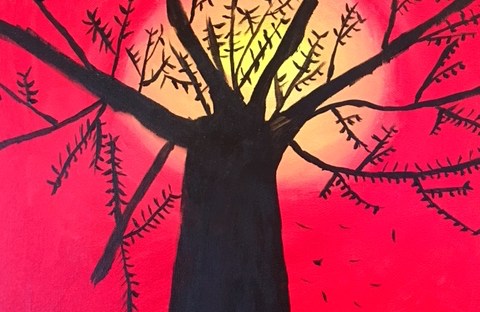
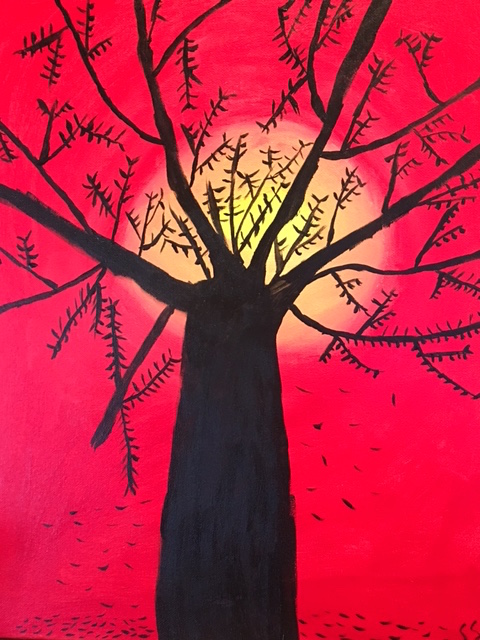
“Ugh.  My leaves look like thorns.  I’ve painted a thorn tree!” I whined.

“What?  No.  You’re too close,” my friend Susan, who was painting right next to me, sagely advised.  “You need to step back and look at the whole thing.”

My weekly Bible study group was at a painting class.  Now, I have no artistic ability whatsoever.  Seriously, I’m not being modest.  I think it’s important that we recognize our spiritual gifts and non-gifts.  I quit Art after sixth grade and took a shop class.  Trust me, I’m no artist.

However, this painting class drew me in–probably because it was held at my favorite local coffee and sweet shop and included a free latte.  And I have to say, it was a lot of fun.  Our painting that evening was a willow tree.  It was amazing to see how twenty-two ladies could use the same materials and get such vastly different trees.

Back to the thorns.  With my nose inches from the canvas, this is what I saw.IMG_0093

But when I stepped back, I saw this.

IMG_0095

It’s not great, so don’t pretend.  The swirling leaves were an added touch I went rogue with.  They were not in the original design.  From this perspective, and with my rogue falling leaves, it doesn’t look as much like a thorn tree.

The point is, perspective changes things.  In our lives, we sometimes stand too close to the canvas.  We get too close to our grief, our worry, our schedules, our drama, our work, our parenting, our volunteering, our aging, our life situations and we forget that there is a bigger picture being painted.

I love the verse from Revelation that opened this post.  God is.  God was.  God is to come.  God is THE Almighty.

God doesn’t just see the complete picture, he IS the complete picture!  But when we’re standing too close to ourselves we can’t see it.  We can’t see him or the work he’s doing.

We see thorns.  God says, I see a tree standing in the midst of a glorious Fall sunset.  (And I’m not talking about whatever that is Sara painted!)

God shapes our lives with boldness and depth.  He adds shades of brilliant color mixed with soft hues and rich earthiness.  All that is and was and is to come stretches out before him in a dazzling mural we can’t even comprehend.  And we only see thorns.

There is a time and place for closeness.  There are moments when we have to be solely focused on the grief, the illness, the budget, the children, the aging parents, the work.  But we also need to learn to take a step back.  We need to work to see the bigger picture, knowing that we won’t ever truly see it all in this lifetime.  We need to remember that we are children of the one who is, who was, and is to come–the Almighty.

Do you only see thorns?  Step back.

Blessings and Peace,

Sara